Op-Ed: Raising the Bottom
Drawing on a powerful concept from Alcoholics Anonymous alongside the Rebbe’s profound maamar Ve’atah Tetzaveh, this thought-provoking Op-Ed explores how our generation can experience the “כתית” that reveals the essence of the soul—not through suffering, but through feeling the pain of the Shechinah’s exile. An inspiring perspective on Golus, Geulah, and our mission to prepare the world for Moshiach • Full Article


By Yitzchak Cohen
One of the most fascinating ideas I have come across is found in Twelve Steps and Twelve Traditions, in its discussion of the First Step.
The First Step begins with an admission of powerlessness and unmanageability. The book explains that this admission does not come naturally. A person’s instincts resist the idea of complete defeat. Yet it insists that, in the case of alcoholism, no lasting strength can be found until that defeat is honestly accepted. What initially appears to be humiliation becomes the foundation upon which an entirely new life can be built.
In the early years of Alcoholics Anonymous, most of those who were able to make that admission were desperate, “low-bottom” cases. Their alcoholism had progressed to the point that its hopelessness could no longer be denied. Less desperate alcoholics often came to AA but were unable to accept that they were truly powerless, and therefore could not fully take the First Step.
But over time, something remarkable began to happen.
People entered recovery while they still had their health, families, jobs, and possessions. They were joined by young people who, in the book’s words, were “scarcely more than potential alcoholics.” These younger people had not yet endured the final ten or fifteen years of suffering experienced by many of the earlier members. The question was: How could someone whose life had not yet visibly collapsed honestly admit that it had become unmanageable?
The answer was that it became necessary to “raise the bottom.”
The earlier members would go back through their own histories and demonstrate that their drinking had been out of control long before they themselves recognized it. What once appeared to be merely a habit was already the beginning of a destructive progression. By hearing where that progression had led others, a younger person could recognize the same pattern beginning within himself.
He did not necessarily have to experience every consequence personally. He could learn from those who had already traveled further down the same road.
But this did not mean that “hitting bottom” was no longer necessary. The book is very clear that a person must still become genuinely convinced of the seriousness of his condition before he will be ready to embrace the attitudes and actions demanded by recovery. The bottom could be raised, but it could not be removed. The person still had to reach the point at which he understood that he could not continue as before.
Perhaps this gives us a way to appreciate one of the most powerful teachings in the Rebbe’s maamar Ve’atah Tetzaveh.
The Rebbe explains the words “כתית למאור”, “crushed for the luminary.”
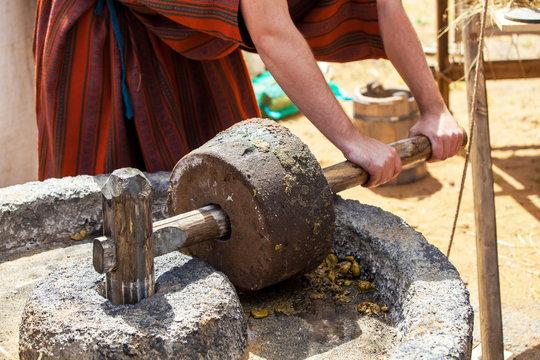
When an olive is crushed, the oil hidden within it emerges. So too, when a Jew is in a state of כתית, something deeper than his ordinary, conscious personality is revealed. The maor, the “luminary,” refers to the essence of the soul, the source from which its light comes.
Throughout Jewish history, this crushing was often painfully literal.
Jews lived under regimes that attempted to suppress Torah and mitzvos. They were pressured, persecuted, imprisoned, and sometimes forced to risk their lives simply to remain openly connected to Hashem. Under those conditions, the essence of the Jewish soul emerged in the form of mesirus nefesh. When every external support was threatened, the essential bond between a Jew and Hashem proved stronger than life itself.
The Rebbe discusses this in connection with the story of Purim.
Chazal explain that the acceptance of the Torah in the days of Achashverosh completed what had begun at Har Sinai. At Sinai, the Jewish people stood at the highest spiritual level and experienced an overwhelming revelation of G-dliness. Yet Chazal still describe that acceptance as being accompanied by a certain element of compulsion, Hashem suspended the mountain over them “like a barrel.”
During the decree of Haman, the situation was the exact opposite. The Jewish people were in exile, surrounded by concealment, with their very existence under threat. Nevertheless, they remained devoted to Torah and mitzvos with mesirus nefesh.
Mordechai, the Moshe Rabbeinu of his generation, gathered Jewish communities and strengthened their faith in Hashem. He inspired them to stand firmly in their study of Torah and observance of mitzvos even when doing so was bound up with actual self-sacrifice. Through Mordechai, their faith did not remain an abstract or surrounding belief. It became internalized and expressed in the way they lived.
Their כתית revealed the maor.
But the Rebbe does not stop there.
The maamar explains that there were actually two dimensions to the Jewish people’s acceptance of the Torah during the period of Purim.
The first took place during Haman’s decree. This was the acceptance expressed through mesirus nefesh while they were under threat.
The second came after the miracle.
After Haman’s downfall, the Jewish people experienced “light, gladness, joy, and honor,” both materially and spiritually. Haman’s house was given to Esther, representing not only the defeat of evil but its transformation toward holiness. They were no longer living under the same danger. Nevertheless, they were still in exile. As the Gemara says, “We are still servants of Achashverosh.”
Even amid abundance, they remained כתית because the world had not yet reached its complete state. The Shechinah was still in golus. The Beis HaMikdash had not yet been rebuilt, and the revelation of Elokus for which creation longs had not yet become manifest.
The Rebbe explains that this second form of כתית is not merely another version of the first. In a certain respect, it expresses an even deeper revelation of the essence of the soul.
A Jew may have everything he needs materially. And nevertheless, he is broken by the fact that the Shechinah remains in golus.
He may enjoy spiritual freedom. He may be free to learn Torah, perform mitzvos, build Jewish institutions, and live openly as a Jew.
And nevertheless, he is broken by the fact that the Shechinah remains in golus.
Why?
Because the true desire of every Jew, a desire that comes from the core of his being, is that G-dliness be revealed. The absence of that revelation is not merely a theological problem. It touches the very essence of who he is.
The Rebbe brings the teaching of Chazal that whoever does not merit to have the Beis HaMikdash rebuilt in his days should regard it as though it were destroyed in his days. When a Jew truly contemplates what this means, that the Beis HaMikdash remains unbuilt and that G-dliness does not shine openly as it did in the time of the Beis HaMikdash, he becomes “אינְגַאנְצְן צּוטְרֵייסְלט,” completely shaken.
This is not necessarily because anything is missing from his personal life.
It is because something is missing from the world.
Hashem is not openly revealed. The Shechinah is in golus. The world does not yet recognize its Creator, and creation has not yet openly become the dwelling place for Hashem that it was made to be.
Perhaps this is where the idea of “raising the bottom” can help us understand what the Rebbe is asking from our generation.
Previous generations experienced an external כתית. Persecution itself shook them and brought the essence of their souls to the surface. Their circumstances made it impossible to ignore what was at stake.
Our generation should not require another chapter of suffering in order to awaken.
We have already seen where golus can lead. We have inherited the experiences of Jews who lived through expulsions, pogroms, the Holocaust, Soviet persecution, and countless attempts to extinguish Jewish life. We know what they endured, and we know what their mesirus nefesh revealed.
But the Rebbe is asking us to go further than remembering their suffering.
He is asking us to understand the true nature of golus itself.
Just as the younger alcoholic is meant to recognize the progression before it reaches its most devastating consequences, we should not require a deeper concealment before recognizing what still remains incomplete and that it is fundamentally unmanageable and unacceptable.
The bottom must reach us now.
Not because our lives have fallen apart.
Not because we have nothing.
But precisely because we may have everything and still understand that the essential thing is missing.
The Beis HaMikdash is not standing.
The Shechinah is not openly revealed.
The world is not yet living with the clear recognition that there is nothing besides Hashem.
The question is not whether we know these things intellectually. The question is whether we have allowed them to become real enough to change us.
If we truly understood what golus is, could we remain comfortable within it?
Could we treat Redemption as a distant subject, an inspiring idea, or merely one more belief among many?
Could we build a beautiful Jewish life while making peace with the fact that the purpose of creation has not yet been openly fulfilled?
The Rebbe is not asking us to become broken in a way that leads to despair.
The purpose of reaching bottom is not to remain at the bottom. It is to become willing to do what one was previously unwilling to do.
Likewise, the purpose of כתית is not pain. It is למאור, to reveal the luminary.
And here the Rebbe adds an even deeper point.
Mesirus nefesh can reveal the essence of the soul while still remaining, in a certain sense, beyond a person’s ordinary thinking and feelings. A Jew may display extraordinary self-sacrifice under persecution, yet when the persecution ends, that same intensity may no longer be apparent in his everyday life.
But when a Jew is shaken simply because he is in golus, even while enjoying material and spiritual abundance, it means that his conscious mind and heart have become aligned with the essence of his soul. His desire for the revelation of G-dliness is no longer expressed only in an extraordinary moment of sacrifice. It has entered the way he thinks, feels, and lives every day.
This is a deeper transformation.
It is not only that a Jew is prepared to die as a Jew.
It is that he has learned to live as a Jew whose entire life demands the revelation of Hashem.
When that becomes real, Torah can no longer be merely one part of life. It becomes the way we reveal the truth of existence.
Mitzvos are no longer isolated obligations. They become the means through which physical reality is transformed into a dwelling place for Hashem.
Every encounter with another Jew becomes an opportunity to reveal the essential faith already present within him.
Every place becomes a place where G-dliness can be revealed.
And every moment becomes part of preparing ourselves and the world for the complete Redemption.
The lesson of “raising the bottom” is not that we can change without confronting reality. It is that we can confront reality before it destroys us.
The lesson of Ve’atah Tetzaveh is not that our generation has no כתית. It is that our כתית can come from a deeper place.
We should not need suffering to tell us that Golus is unbearable.
We should know it because the essence of our souls knows it.
We should feel it even when life is comfortable, even when Torah and mitzvos can be observed freely, and even when we are blessed materially and spiritually.
Our prosperity should not conceal the one fact that changes everything:
The Shechina is still in Golus.
And when that truth reaches us deeply enough, it does not lead us to hopelessness. It makes us ready to change, to leave behind the assumptions and limitations of an exile mindset, to increase in Torah and mitzvos, to reveal G-dliness throughout the world, and to live every part of our lives with one clear purpose:
To prepare ourselves and the entire world to greet Moshiach and fully enter the complete and true Geulah.
88
Join ChabadInfo's News Roundup and alerts for the HOTTEST Chabad news and updates!

Related Posts:



Most Popular



New Videos

Editor's Picks