
Israel, Lebanon Reach U.S.-Brokered Framework Agreement
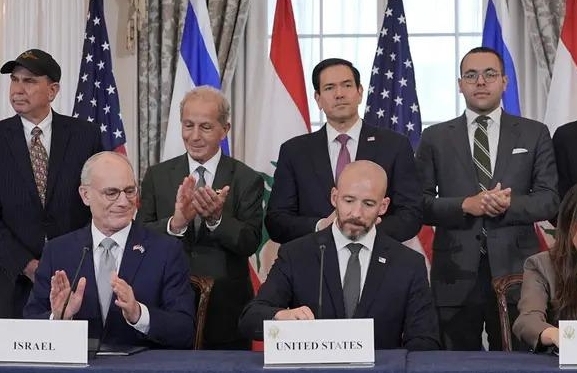
The governments of Israel and Lebanon have signed a U.S.-brokered framework agreement in Washington aimed at ending decades of conflict and establishing a pathway toward a comprehensive peace agreement • Read More


The governments of Israel and Lebanon have signed a U.S.-brokered framework agreement in Washington aimed at ending decades of conflict and establishing a pathway toward a comprehensive peace agreement.
The accord, announced by the U.S. State Department, lays out a gradual process centered on the disarmament of Hezbollah, the restoration of Lebanese government control throughout the country, and the eventual withdrawal of Israeli forces from Lebanon.
According to the full text released by the U.S. State Department, Israel and Lebanon reaffirm one another’s right to exist in peace and declare their intention to formally end the state of conflict between the two countries. The agreement states that the Lebanese Armed Forces will gradually restore full sovereignty across Lebanon following the ‘verified disarmament’ of all armed groups operating outside state authority, while Israel will progressively withdraw from Lebanese territory as those conditions are met.
As part of the initial phase, the Lebanese army will assume full security responsibility over two pilot areas in southern Lebanon that were previously controlled by Hezbollah. Future transfers of territory will require mutual agreement and verification that armed groups have been disarmed and their infrastructure dismantled.
The Lebanese government commits to reestablishing its monopoly over the use of force throughout the country, dismantling all non-state armed organizations, and ensuring such groups no longer maintain military or security capabilities anywhere in Lebanon. Beirut also formally requests international assistance – particularly from the United States and Arab states—to accomplish that objective.
Israel states in the agreement that any future military action in Lebanon would be limited to responding to attacks, threats, or hostile intentions by Hezbollah. It further declares that once the Hezbollah threat has been eliminated, there will no longer be a need for an Israeli military presence inside Lebanon, while emphasizing that it has no territorial ambitions in the country.
The agreement also affirms that the Lebanese government alone holds the authority to declare war or peace and that any use of force by organizations outside the state’s official security forces constitutes a violation of Lebanese law.
While both countries reaffirm their inherent right to self-defense under international law, they also agree to establish a joint Military Coordination Group with U.S. participation to oversee implementation of the framework.
In addition to the security provisions, the United States pledged to mobilize international partners to assist Lebanon’s reconstruction through humanitarian aid, infrastructure rebuilding, economic recovery, and investment initiatives. Lebanon also committed to preventing reconstruction funds from reaching Hezbollah or any other non-state armed organizations.
The framework further calls for the creation of working groups that will draft a comprehensive peace and security treaty. Israel and Lebanon also agreed to cease hostile actions against one another in international political and legal forums and to cooperate in locating and returning human remains and detainees.
The agreement concludes by expressing appreciation for the role of the United States and the leadership of President Donald Trump in advancing the negotiations.
Despite the diplomatic breakthrough, significant questions remain regarding implementation. Hezbollah has publicly rejected the agreement, calling it a surrender and refusing to disarm, while analysts have questioned whether the Lebanese government possesses the ability to enforce the framework.
In Israel, the agreement has already drawn criticism from some members of the government.
National Security Minister Itamar Ben-Gvir called the deal “a major mistake,” saying he has asked Prime Minister Benjamin Netanyahu to bring the agreement to a Cabinet vote.
“The agreement with Lebanon is a major mistake,” Ben Gvir said. “We may remain in most of the territory for now, but the Lebanese state will not disarm Hezbollah. Hezbollah ministers sit in the Lebanese government, and it is impossible to rely on Lebanon to take Hezbollah’s weapons. I will demand a Cabinet vote.”
He added, “Only IDF soldiers will destroy Hezbollah—no one else will do it for us.”
58
Join ChabadInfo's News Roundup and alerts for the HOTTEST Chabad news and updates!

Related Posts:




Most Popular




New Videos

Editor's Picks