



Behind the Beis Din’s Letter: The Dispute, the Agreement, and What Comes Next
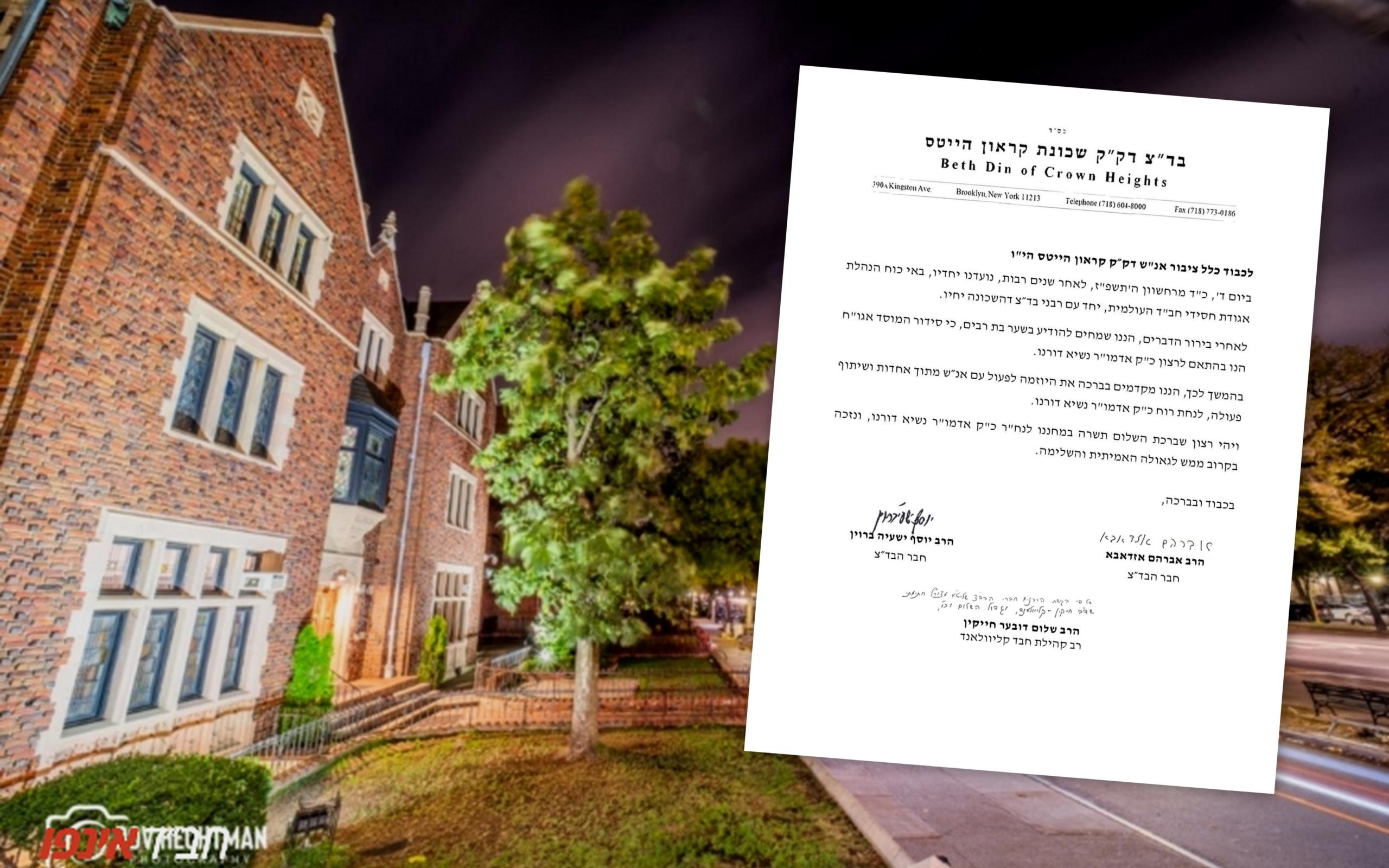
A brief statement issued Thursday by the Crown Heights Beis Din quickly went viral, sparking widespread discussion, speculation and debate among Chabad Chassidim around the world. What is behind the letter, and what does it mean? A first reading leaves more questions than answers, but a closer look helps shed light on the developments • Full Story


By Shraga Crombie, ChabadInfo
A brief statement issued Thursday by the Crown Heights Beis Din quickly went viral, sparking widespread discussion, speculation and debate among Anash and Chabad Chassidim around the world. In the statement, the rabbanim serving on the Beis Din of the Crown Heights community wrote that, after many years, they had met with representatives of Agudas Chassidei Chabad (Aguch), and announced that the organization’s structure is in accordance with the Rebbe’s wishes.
What is behind the letter, and what does it mean? A superficial reading leaves more questions than answers, and one can certainly welcome the move toward unity and peace among Chassidim. However, a closer examination helps shed some light on the developments. Here is what can be established:
The roots of the matter go back to the period immediately following Gimmel Tammuz, when The Rebbe’s Tzavaah was published. In it, the Rebbe appointed his secretary, Rabbi Chaim Mordechai Aizik Hodakov, Rabbi Zalman Gurary and Rabbi Dovid Raskin to oversee the management of Aguch.
The Rebbe also designated the leadership of Merkos L’Inyonei Chinuch to Rabbi Chaim Mordechai Aizik Hodakov, Rabbi Nissan Mindel and Rabbi Shalom Mendel Simpson.
Machne Israel was entrusted to Rabbi Chaim Mordechai Aizik Hodakov, Rabbi Nissan Mindel and, Rabbi Chaim Yehuda Krinsky Sheyichye.
In response, leading Chabad rabbanim issued a Public Declaration affirming that the will represented the Rebbe’s holy wishes. However, those who had been managing the institutions before Gimmel Tammuz argued that the will had not been signed and therefore was not binding.
The matter was brought before the Crown Heights Beis Din, which Invited the parties involved to appear for a Din Torah through a Zabla arrangement — meaning that the case would not necessarily be heard by the local rabbanim, but before a Beis Din selected by the parties themselves. Rabbi Chaim Yehuda Krinsky and Rabbi Avraham Shemtov declined to appear for the proceedings.
Following their refusal, the rabbanim issued a Ksav Siruv — a formal notice of refusal to appear before Beis Din — and instructed Rabbi Simpson and Rabbi Mindel that they were responsible for managing Merkos L’Inyonei Chinuch and Kehot Publication Society.
[It should be clarified that this dispute has no connection to the question of who manages the Lubavitch Shul and Beis Midrash at 770 Eastern Parkway. The Rebbe entrusted the management of the shul to its gabbaim, as distinct from ownership of the building, which belongs to Aguch and Merkos. However, following the issuance of the aforementioned Ksav Siruv, the gabbaim refused to allow those subject to the notice to hold gatherings and Farbrengens in 770. As a result, events organized by those individuals were moved to the Beis Rivkah hall in Crown Heights. In the years that followed, after they continued to refuse to appear before the Beis Din or a Zabla panel, the plaintiffs representing Aguch and Merkos turned to secular courts in an effort to have the gabbaim removed.]
At the heart of the dispute was a fundamental question: Are the organizations established by the Rebbe to administer Chabad, and which operate from Crown Heights, subject to the authority of the neighborhoods rabbanim or not?
For decades, those claiming leadership of Aguch and Merkos refused to recognize the authority of the Crown Heights Beis Din, maintaining that they were answerable only to the Vaad Rabbonei Lubavitch.
The letter issued yesterday marks the culmination of a process in which those parties recognized the authority of the Beis Din over Agudas Chassidei Chabad. In turn, the Crown Heights rabbanim decided to recognize them as the organization’s leadership.
This covers what is stated in the letter. But just as important is what it does not address.
First, the letter refers only to the leadership of Agudas Chassidei Chabad. It does not address Merkos L’Inyonei Chinuch or Machne Israel, since an understanding recognizing the authority of the Beis Din has not yet been reached with those claiming leadership of these institutions.
Second, the letter does not rescind the Ksav Siruv against those who have refused to appear before Beis Din. That said, it remains possible that this will change in the near future, should they agree to submit to the authority of the Beis Din and appear before its rabbanim.
Third, the letter makes no mention of the pressing issue of who manages 770. Even following the recognition of the Beis Din’s authority, the court case has not been withdrawn, and the matter has not been brought before the Crown Heights rabbanim for a Din Torah.
Bottom Line
This is a welcome development, and one that appears to mark only the beginning of a broader process. Further developments may follow as recognition of the authority of the rabbanim serving on the Crown Heights Beis Din takes hold.
183
Join ChabadInfo's News Roundup and alerts for the HOTTEST Chabad news and updates!

Related Posts:



Most Popular




New Videos

Editor's Picks


















Really appreciate this! The only site that actually reports real stories. Thank you Chabad.info