Torah, Free Will, and Science: How & Why Torah Is Our Greatest Protection
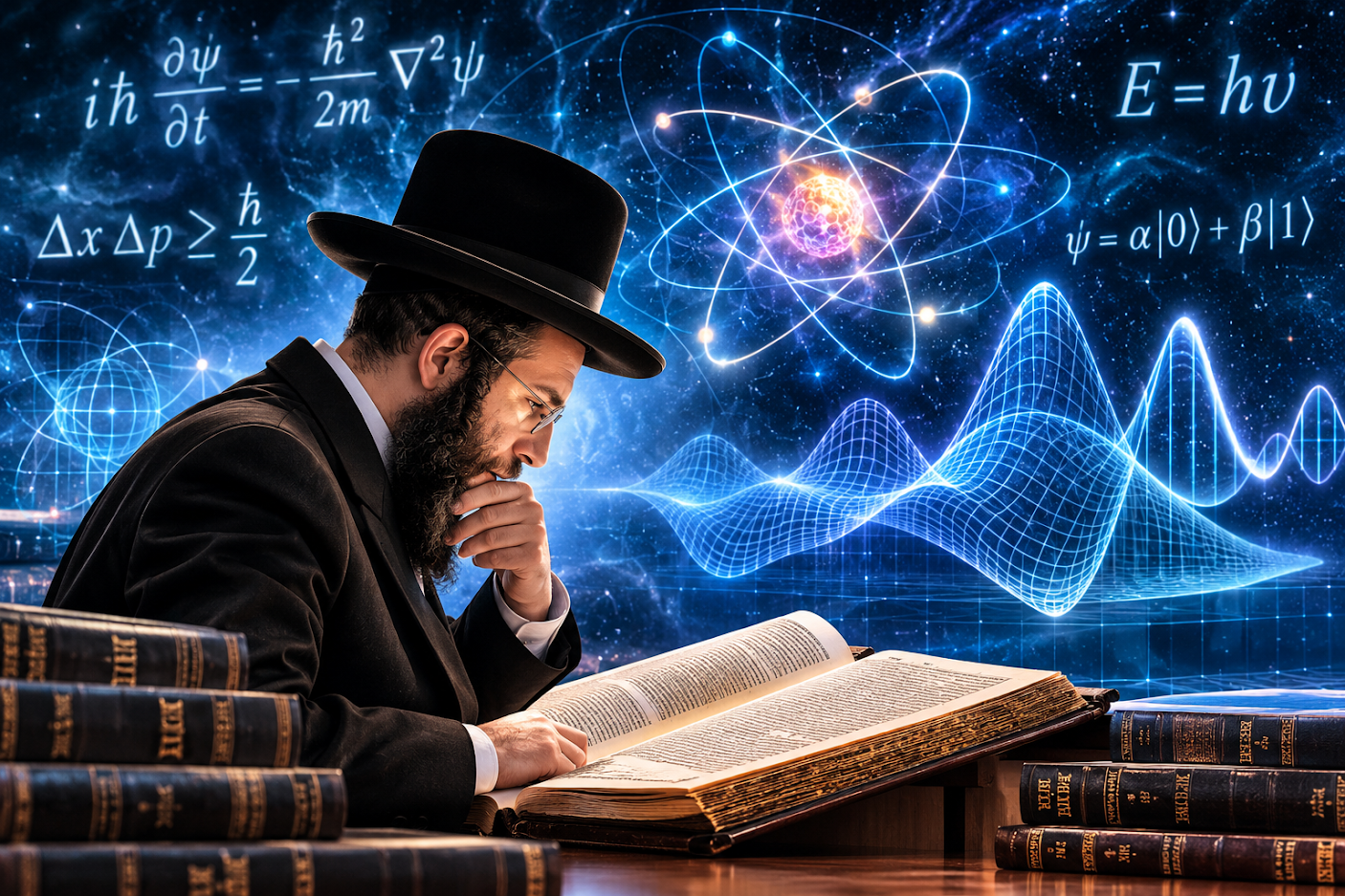
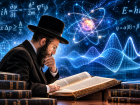
Can quantum physics explain how our choices shape reality? In this week’s thought-provoking article, Rabbi Shlomo Ezagui explores the connection between modern science and Torah, examining the role of human perception, free choice and personal responsibility in shaping the world around us • Full Article


By Rabbi Shlomo Ezagui
The advent of modern quantum mechanics, particularly through the Copenhagen interpretation formulated by Niels Bohr and Werner Heisenberg, marks a profound shift in our understanding of physical reality. In quantum mechanics, a physical system—famously illustrated by Erwin Schrödinger’s cat paradox—remains in a state of indeterminacy, a superposition in which the cat is neither strictly alive nor dead, until an observer interacts with it through observation and measurement. As Heisenberg powerfully noted, especially when considering the spiritual underpinning of physical reality, “What we observe is not nature itself, but nature exposed to our method of questioning.”
This scientific view grants humanity a tremendous sense of agency; our input, engagement, and observation do not merely record reality but actively participate in collapsing wave functions and shaping outcomes. A system’s physical state before observation is fundamentally distinct from its state after observation. Albert Einstein famously resisted this non-deterministic implication, expressing his skepticism to Abraham Pais by asking whether he genuinely believed “that the moon exists only when I look at it.”
Yet human beings are not gods. Only one Creator brought the universe into existence ex nihilo (something from nothing). According to the Torah, the universe has an objective baseline reality because God declared it at Creation, and this is recounted to us in the Torah as ultimate truth: “And God saw everything that He had made, and behold, it was very good” (Genesis 1:31). If God created a world that is inherently real, what precise role does human observation play in a framework where measurement appears to dictate reality?
The Torah’s perspective holds that human beings do not possess absolute, unbridled agency over the physical cosmos. If every individual possessed total command over outcomes, human wills would constantly collide. One person’s interest often directly opposes another’s. A striking illustration of this balance appears in the Talmud (Yoma 53b) regarding the High Priest (Kohen Gadol). On Yom Kippur, the holiest day of the year, when entering the Holy of Holies, the High Priest offered a precise prayer: he asked that God not grant the prayers of travelers who requested dry weather, because their preference for easy travel conflicted with the farming community’s essential need for rain. Human desire must be balanced within a broader ecosystem, a synthesis only the Infinite Creator can manage.
Similarly, when two opposing forces pray for victory, both cannot win. God ultimately decides the outcome of physical events, balancing the needs of the whole world with absolute justice. As Pirkei Avot (Ethics of the Fathers 2:16) instructs, man’s duty is to exert effort (hishtadlut): “It is not your duty to finish the work, but neither are you at liberty to neglect it.” Human responsibility lies in making the effort and exercising moral choice; the ultimate result remains entirely in the Almighty’s hands.
Where, then, does the individual’s observation and action shape reality? The Torah reveals that within specific, designated realms—specifically the choice between good and bad, pure and impure—God grants humanity genuine agency. Within this defined domain, human free choice and active perception directly determine outcomes. Modern physics shows that, as John Archibald Wheeler coined, we inhabit a “participatory universe” at the quantum level, where the observer is indispensable. Far from being a modern discovery, this principle of (limited) observer-dependent reality has been embedded in the fabric of Jewish law (Halakha) since the giving of the Torah at Sinai.
To demonstrate how divine law recognizes the subjective observer in shaping practical reality, we look to two specific rules codified by Maimonides (Rambam) in his Mishneh Torah:
In the laws of ritual purity (Hilchot Keilim 6:1), a vessel capable of contracting impurity (tumah) loses that susceptibility once a hole renders it nonfunctional. The standard benchmark for a vessel to become pure is a hole large enough for a medium-sized pomegranate to pass through. Maimonides clarifies that this measurement is not determined by an absolute, universal standard but by the “subjective estimation of the individual observer”.
This raises an obvious question: how can Jewish law establish a rule based on subjective judgment when no two individuals perceive things identically? As the Talmud states in Berachot 58a: “Just as their faces are not alike, so too their thoughts are not alike” (keshem she-ein pantheihem shavot, kach ein de’ateihem shavot). How could Moses transmit a law from Sinai that relies on personal impression and could create endless variability?
The sages explain that while most Torah laws set strict quantitative limits, this particular law explicitly empowers the individual to visualize a small and a large pomegranate and, within reasonable parameters, determine what constitutes a medium pomegranate. In this instance, the law is this! God grants the observer direct authority to establish concrete, physical reality through their own perception, with all the serious consequences that follow.
A second clear instance of observer-dependent reality appears in the laws of tzara’at (biblical skin, garment, or wall afflictions). A specific discoloration determines whether a structure, garment, or person is ritually impure or pure.
Maimonides notes (Hilchot Tumat Tzara’at 15:8) that if a house suspected of having an affliction is dark and lacks windows, we do not open windows or introduce artificial light to inspect the walls. The inspection is conducted strictly based on what the observer sees inside the house at that moment! Regardless of what the wall “might look like” under ideal conditions, the halakhic reality is dictated solely by what the observer can see under existing conditions. If the observer sees no discoloration, the house is declared strictly pure. Human observation actualizes the physical reality of ritual purity or impurity.
These halakhic principles show that modern scientific discoveries are not new inventions but the unfolding of underlying physical laws that reflect the Torah’s deeper wisdom. The physical universe is an outer manifestation of an inner spiritual structure. Science reveals at the physical, observable level what the Torah established spiritually thousands of years ago: human engagement, perception, and effort are pivotal in shaping the world around us.
Torah study connects the individual directly to the underlying engine of creation. As the Zohar (Vol. III, 161b) famously proclaims: “God looked into the Torah and created the world” (istakal be-Oraita u-vara alma). Understanding modern science through the lens of Torah allows us to appreciate our sages’ words with unprecedented clarity: Torah study is the ultimate source of strength and vitality, providing the spiritual blueprint from which all physical reality derives its (blessings) existence.
And this brings us back to the greater message.
Modern science increasingly helps us appreciate the decisions and choices we make and the very real influence our perspective has on the world around us. The universe is not merely a collection of independent objects operating in isolation. Quantum entanglement and observer effects reveal underlying structures, relationships, and principles that govern how the world functions. What we see on the surface is only an expression of something much deeper. The Torah, as our sages teach us, is the blueprint of creation. It contains the inner wisdom and governing principles by which God brought the universe into existence.
This is why the study of Torah is far more than the study of ancient religious traditions or a set of rules governing Jewish life. It connects us with the very source of existence. As King Solomon declared in Proverbs (3:18): “She is a tree of life to those who lay hold of her, and happy are all who hold her fast.” The Torah gives us direction, strength, and insight into our responsibility in very real, concrete terms. It teaches us where we have the freedom to act, where we must recognize our limitations, and how our choices can make a genuine difference.
Today, we can appreciate this more than ever. What modern science reveals at the observable, physical level offers another opportunity to recognize the extraordinary depth of the wisdom given to us thousands of years ago. The outer world reflects an inner truth. The energy, structure, and principles underlying what we see around us find deeper expression in Torah wisdom.
Perhaps this is one of the most powerful lessons of all: We are neither powerless spectators in the universe nor its absolute masters. God has given us a meaningful sphere of influence, the freedom to choose, the responsibility to act, and the ability to affect the world around us. We must make an effort, exercise our judgment, and do what is right. The ultimate outcome belongs to God. The more we study the Torah, the more we discover that its wisdom is not disconnected from the world we live in. It is the very foundation upon which that world stands. Modern science does not diminish the Torah’s eternal wisdom—it gives us new eyes to appreciate it.
www.rabbishlomoezagui.com
1
Join ChabadInfo's News Roundup and alerts for the HOTTEST Chabad news and updates!

Related Posts:




Most Popular


New Videos

Editor's Picks