The World Is Starting to Give Away Its Secret
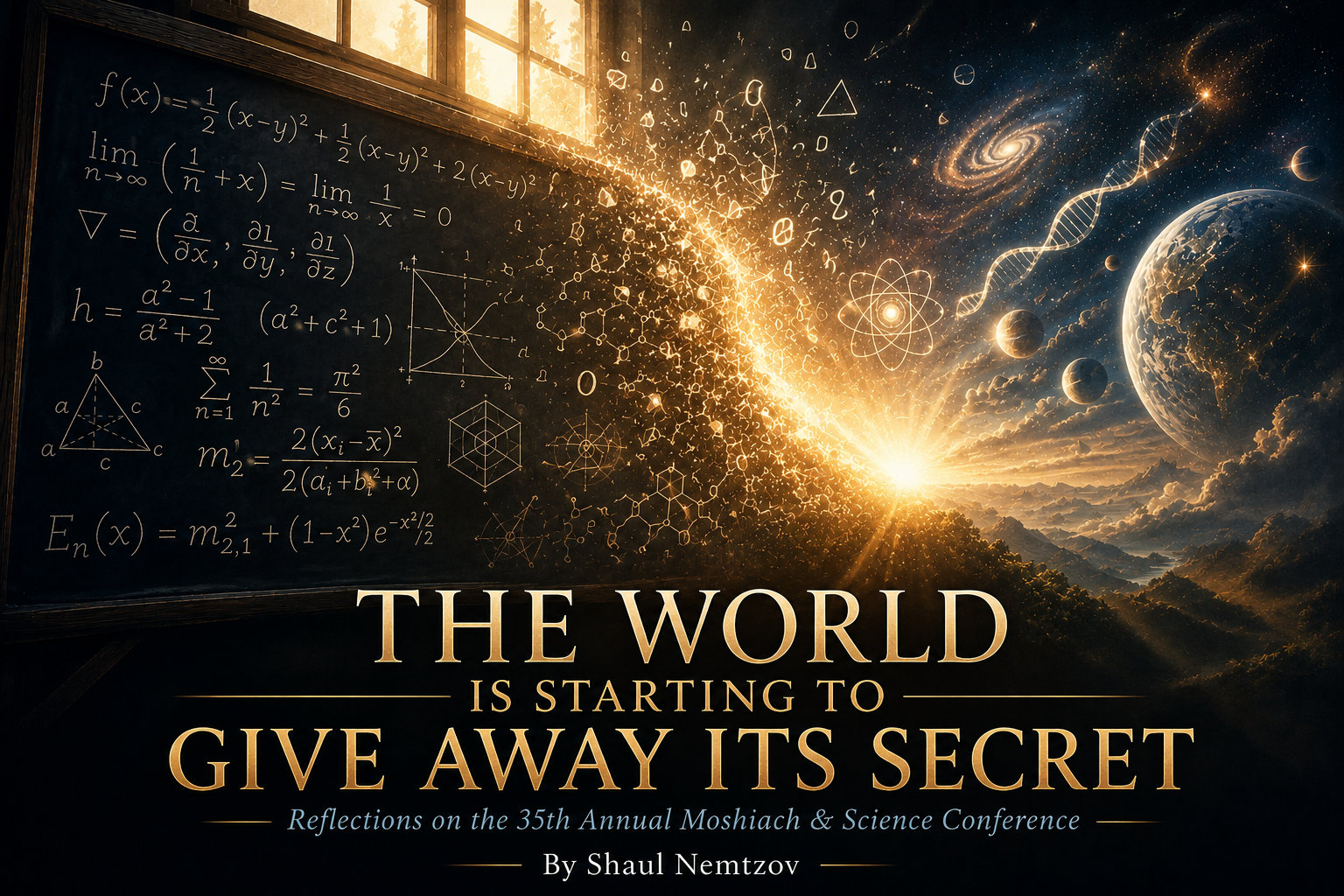
From a yechidus in 1973, to this year’s 35th Annual Moshiach & Science Conference, Shaul Nemtzov reflects on the massive success of the RYAL institute, honoring the legacy of Rabbi Yisroel Aryeh Leib, the Lubavitcher Rebbe’s youngest brother • Full Story


By Shaul Nemtzov
It began in late 1973 winter during the quiet, heavy air at 3:40 a.m.
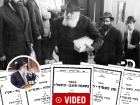
Professor Shimon Silman and his wife of a few months came to see the Rebbe. They were the last to enter Yechidus that night. He placed his PAN (personal note) on the desk, expecting the Rebbe to ask about his recent marriage or spiritual commitment to fully transition to a Chabad lifestyle, coming from Litvish backgrounds.
Instead, without even looking up from the note, the Rebbe asked a single, piercing question: ‘What is your profession?’
At the time, Silman was just a teaching assistant in mathematics, but the Rebbe’s gaze seemed to look right through him, seeing a future he hadn’t yet realized. For years, whenever Silman wrote to the Rebbe about taking jobs in religious studies, he received no reply. But whenever he wrote about developments in his mathematical work, the Rebbe responded with an immediate blessing. He eventually realized the Rebbe’s far-reaching ‘gaze’ was for the Professor not to leave the world of mathematics, but to find HaShem within it.
Two Worlds
Don’t you feel like science and religion are coming from two totally different worlds?
People who search for evidence, logic, and reasoning look to science for answers.
People who search for meaning, purpose, and connection to a higher power immerse themselves in religion.
Even when people try to reconcile science and religion, they often still seem like they’re both just talking at each other — never having the same conversation.
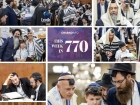
But this year’s 35th Annual Moshiach & Science Conference enlightened me.
The deeper we investigate the physical world, the more it seems to reveal a reality beyond itself.
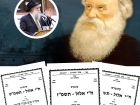
Of course, much of the Moshiach & Science Conference revolves around the legacy of Rabbi Yisroel Aryeh Leib, the Lubavitcher Rebbe’s youngest brother.
What fascinates me about him is that he doesn’t approach science as an enemy that must be silenced, nor as a tool that must be bent to fit Torah.
Instead, he looks science straight in the eye.
Professor Noson Yanofsky explained, drawing on the mathematical paper written by Rabbi Yisroel Aryeh Leib and later published by the Rebbe, that when science honestly follows its own questions to their furthest conclusions, it eventually leads to realities that lie beyond the boundaries of logic alone.
The world, in a sense, begins pointing upward and beyond itself.
That idea completely reframed how I think about faith.
We often imagine faith working from the top down: first we strengthen our belief in HaShem, and then we try to see the world through that lens.
But what if we flip the script and look at it from the other way around?
That the more honestly we investigate the world, the more the world itself reveals its Creator.
Bridging science and religion isn’t a new agenda. Going back to 1991, while researching the Rebbe’s letters on Torah and science, Silman noticed a letter dated the 13th of Iyar — the yartzeit of the Rebbe’s brother, Rabbi Yisroel Aryeh Leib (RYAL). Realizing the 40th yartzeit was approaching, he proposed a conference titled ‘Moshiach Through the Eyes of Science.’
Then in 1993, organizing a second conference felt like a daunting task — especially since the 40th-anniversary milestone had already passed. Because of the Rebbe’s health at the time, communication was limited to ‘yes’ or ‘no’ answers. Yet, when Silman asked if he should continue the conferences and publish the previous year’s findings, the answer was a resounding ‘Yes’ on both counts. This transformed a one-time event into a permanent institution, eventually leading to the publication of the book Scientific Thought in Messianic Times.
This wasn’t just about organizing meetings but about creating a permanent home for the idea that the physical world is not an obstacle to G-dliness. By naming the institute after the Rebbe’s brother, it serves as a constant reminder that when we look at the world through the lens of ‘Moshiach logic,’ the boundaries between the lab and the study hall begin to fade away.
The Rebbe’s positive response has continued to power this into an annual conference for over three decades so far. It was as if the Rebbe was appreciating RYAL’s mathematical genius as the key to unlocking a new way of seeing the world — a ‘science of redemption’ that we are still exploring thirty-five years later.”
Korach Was Too Early
Preparing for Gimmel Tammuz, I’ve been learning the Rebbe’s maamar Hasam Nafsheinu from 5718.
Korach.
He recognized something profound.
If HaShem created the physical world, then the physical world must itself be valuable.
In a certain sense, Korach wasn’t entirely wrong.
He was just early.
The world wasn’t ready. It had not yet completed its mission. We still needed to refine the physical world.
His mistake wasn’t appreciating the physical world.
The mistake was trying to live in the reality of Geulah before the world was ripe enough for it.
And perhaps that’s what makes our generation so unique.
For thousands of years, the emphasis has been on elevating the world toward holiness.
But now, more and more, it feels as though the world itself is beginning to reveal the holiness embedded within it.
Down to Earth
The Rebbe repeatedly taught that the goal is not to escape the world.
The goal is to transform it.
Or perhaps even more accurately, to reveal what it truly is — a dwelling place for HaShem.
In that Maamar, the Rebbe instructs that we must begin with Kol Ma’asecha Yihyu L’Shem Shamayim — to first ask ourselves what HaShem wants us to do.
Then, by engaging with the world in the appropriate manner, we ultimately reach the fulfillment of B’chol Derachecha Da’eihu — to see HaShem from within the world itself.
In other words, first we bring G-dliness into the world, and then we discover that G-dliness was there all along.
As a businessperson, I sometimes get to see this.
How often did the Rebbe encourage professionals to develop their own discoveries using their own language and the tools of their trade?
Experts in every discipline were encouraged to push their fields forward. For example, psychologists were encouraged to help people heal emotionally through the language and tools of psychology. Scientists were encouraged to continue discovering creation. And every expert was expected to utilize his or her field of expertise to better the world.
Take the famous bacteriologist and public health Professor Dr. Velvl Greene.
The Rebbe took a deep, active interest in Dr. Greene’s actual secular research. He specifically asked Greene to mail him his scientific papers and laboratory findings. Dr. Greene once hesitated to send them, thinking the Rebbe was far too busy with his global leadership to read some niche microbiology papers.
The next time the Rebbe saw him, he called him over and said, “You promised me the reports! Don’t have pity on me. Send the reports.” Greene compiled folders of unclassified NASA documents and sent them. The Rebbe actually read them with a critical eye. In one instance, he pointed out an apparent contradiction between two sections of a report where Greene’s team had speculated on whether certain bacteria could survive in the Martian environment. When Greene admitted it was a minor oversight, the Rebbe replied, “Thank you. You make me feel better. I don’t like contradictions in science.”
Perhaps a more everyday example is mental health.
In the late 1970s, Western culture experienced a massive boom in Eastern meditation practices, most notably Transcendental Meditation (TM). Millions of young people — including an enormous percentage of Jewish youth — were turning to these practices to combat the stress and anxiety of the modern-day fast-paced lifestyle. The Rebbe recognized that these youth were genuinely suffering from “nerves” and anxiety, and that meditation actually worked to calm them. However, TM and other contemporary methods embedded subtle (and sometimes overt) elements of Avodah Zarah (idolatry), such as bowing to gurus, burning incense, or chanting mantras linked to deities.
In 1977, the Rebbe issued a public, sweeping mandate specifically addressed to Jewish psychologists, psychiatrists, and medical professionals, charging them with a unique “holy obligation.”
The Rebbe did not simply tell people to stop meditating. He recognized the therapeutic utility of the tool. Instead, he charged mental health professionals to strip away the Eastern religious components and develop a purely medical, scientific, or Torah-compliant alternative.
He described it as a Kosher-approved meditation to “baru’iken die nerven” (to calm the nerves). But he wanted it to come from the recognized psychologists, not from Rabbis or religion.
Why?
Perhaps because the goal was never to replace the world.
But to reveal it.
Perhaps Geulah doesn’t only have to look like Heaven interrupting Earth.
Perhaps it’s meant to look like Earth finally revealing the Heaven that’s been within it from the very beginning.
Does this sound like the Rebbe’s approach to a Baal Teshuva?
Often, the Rebbe didn’t want the Baal Teshuva to lose their uniqueness and insisted they retain remnants of their previous lifestyle. Once, Professor Herman Branover shared with the Rebbe that he wanted to start wearing a Chabad hat instead of his berét, and the Rebbe responded that without his berét, “You wouldn’t be Branover.” The purpose of course was to elevate their previous lifestyle and bring it into the realm of holiness.
Well, the Rebbe similarly encourages people to not get down by their past and instead see it for the springboard that it is — to bring us to the ultimate destination of making this world into a dwelling place for HaShem.
In the Rebbe’s encouraging words:
“When a person considers the spiritual situation of the world at large, [he may be overwhelmed] by the day-to-day increase of spiritual darkness… This can lead to despair, causing a person to think: ‘How is it possible for me to muster the strength to endure the darkness and illuminate the world with the light of the Torah and its Mitzvos?’
“In reply, he should understand that all of the descents, veils and concealments are merely external factors. When looking at the inner dynamic, one appreciates that, on the contrary, the world does not control its own destiny. It is being directed by G-d, and we can be certain that G-d’s intent is that everything that occurs in the world — even those elements which appear to be darkness and descent — is intended to lead to the world’s refinement and elevation. Thus, this descent is really merely a preparatory step for — and itself a part of — that ultimate ascent. And thus from day to day, the world is reaching a higher level and becoming more refined, until eventually, it will reach its consummate fulfillment, when it will be realized that it is G-d’s dwelling.”
For All To See
Rabbi Shloma Majeski took this a step further during the conference. He pointed out that we’ve reached a historic tipping point: Miracles are no longer ‘religious secrets’ that need to be translated for the secular world.
We have entered a unique era where miracles no longer require a top-down religious explanation to be recognized. They are so obvious that even those who are not religious or who lack a Torah background can see them. Even secular military experts are witnessing events — like missiles falling harmlessly or people being protected in seemingly impossible ways — that many find difficult to explain through ordinary expectations.
When the miracles become this open, it is no longer Heaven interrupting Earth, but rather the physical world itself testifying that its Master has no limitations.
The physical world’s own logic is beginning to admit it has no natural explanation. It’s not just that we are looking for G‑d; it’s that the world is making it impossible for us to look away.
The Plan All Along
Drawing from how the Rebbe explains the Zohar, Silman emphasizes that the “fountains of wisdom from below” — the surge of scientific discovery beginning in 1840 — are a vital and necessary component in preparing the world for the Geulah.
He explains that modern-day scientific developments are not accidental; they serve as a fundamental precursor to the revelation of G-d’s absolute unity — by first uncovering the inherent unity within nature itself.
Silman also drew from a relatively recent science discovery that literally presents a new paradigm for viewing the world.
Think about how we usually solve problems. Right now, our brains mostly work like a simple computer: things are either true or false, black or white, a 0 or a 1. This is referred to as two-valued logic.
Doesn’t that way of thinking just feel so rigid?
Let’s call it “Golus Logic.”
However, with the onset of the Moshiach times, a new dimension is being added to the equation. In addition to just one or the other, yes or no, 0 or 1, both can coexist. In other words, nature as we know it and miracles that defy that nature can work together.
“Imagine there are two boats,” Silman illustrates from a Medrash, “and one wants to go North and the other South. With a Galus mentality, it would be impossible to satisfy both. There would either have to be a North wind or a South wind. But when Moshiach comes, there will be a multi-directional wind enabling both to move in their own directions at the same time.”
A Different Future
When the conference ended, I didn’t leave feeling that science somehow fit Torah or that religion won the argument.
I left with an expansive feeling that the boundaries between the physical and the spiritual are far slimmer than I once imagined.
The world no longer feels like a barrier to G-dliness — it feels more like a witness to it.
If you missed the conference, I highly recommend watching the replay.
And if you’d like to explore these ideas further, Silman has written an entire book Swords Into Plowshares that offers a fascinating look at how developments in science, technology, and world events are all leading to the prophetic vision of redemption. Yanofsky has also written books as well as Rabbi Majeski, and they are all worth looking into.
So the question is:
What if the Geulah is already unfolding?
What if all we need to do is open our eyes to see it all happening?
Resources
For the replay of this year’s Moshiach and Science conference, visit: youtu.be/zTxPc59Mtg8
For Professor Silman’s book Swords Into Plowshares: A Prophecy In Progress and contact information, visit: ryal.org
For Professor Yanofsky’s book The Outer Limits of Reason: What Science, Mathematics, and Logic Cannot Tell Us and contact information, visit: sci.brooklyn.cuny.edu/~noson/
For one of Rabbi Majeski’s book, The Chassidic Approach To Joy, visit: chabad.org/88574
For Dr. Greene’s encounter with the Rebbe, visit: chabad.org/2436891
For more information on applying the Rebbe’s mandate for a Kosher meditation method, visit: koshermeditation.com
For the Maamer Hasam Nafsheinu, visit: projectmelukat.org/hasam-nafsheinu-bachaim-5718 and esicha.org/product/eternal-life/
For the Rebbe’s encouraging words and the full Sicha in English, visit: chabad.org/148619
For the Rebbe’s Sicha on the “fountains of wisdom from below,” visit: chabad.org/4561755 and chabad.org/6132202
98
Join ChabadInfo's News Roundup and alerts for the HOTTEST Chabad news and updates!

Related Posts:


Most Popular


New Videos

Editor's Picks