Q&As: Educating Children To Say Brachos
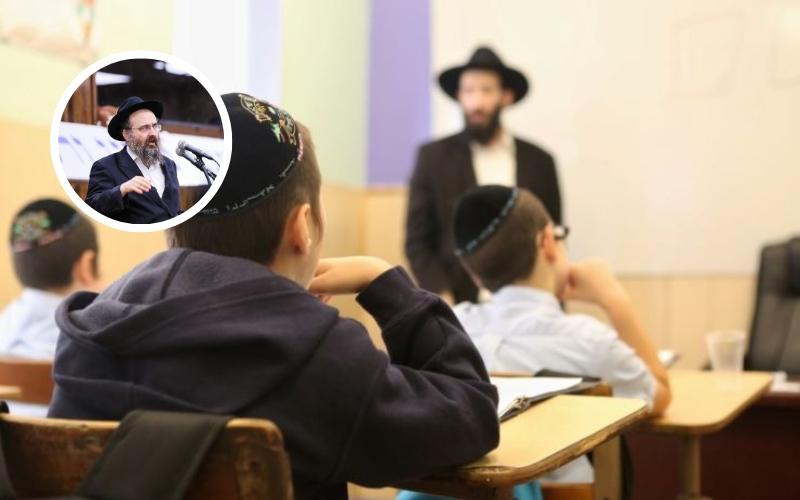
The following are halachic Q&As about chinuch of children to say brachos from AskTheRav.com and Halacha2Go, under the auspices of HaRav Yosef Yeshaya Braun, Mara D’Asra and member of the Crown Heights Beis Din • Prepared for publication by Beis Moshiach Magazine • Full Article


Teaching a Bracha in Parts
Q. Can young children be taught a Bracha, part at a time? For example: To say the first couple of lines of asher yatzar (repeating after the teacher word by word) and once they’ve mastered this, to add on another line etc?
A. Both from a halachic perspective, as well as a chinuch perspective, it would be better to teach the full bracha, with the teacher saying word by word and the child repeating (even if they don’t say every word). This way they learn that there is only one bracha and there are no shortcuts. If the child is older and should be able to say the full bracha and is not pronouncing it correctly, the teacher may ask them to say the line over and over again so they learn how to pronounce it properly. In this case, Hashem’s name should not be repeated. #2212*
Brachos For Children
Q. What is the Halacha regarding saying Al Netilas Yadayim and Birkas HaMazon for children who will eat less than a k’zayis: Should I teach them to not say Al Netilas Yadayim and not to Bentch?…
A. The blessing of al netilas yadayim is only if one will eat an egg-sized portion of bread. In addition, one would need to eat that amount no more than 8 minutes, half of it – a k’zayis – within 4 minutes. In any case, washing would be necessary for any size of bread.
Birchas HaMazon is said [only] if one will eat a k’zayis of bread within 4 minutes.
According to R. Chayim Naeh a k’zayis size is approximately 1 ounce or 27 grams, and an egg size is approximately double that size. There is room to be lenient and measure a k’zayis at slightly less than that amount.
Q. What about Bentching for the rest of the meal they ate? Do they say Borei Nefashos?
A. If no sufficient size of bread was eaten, the appropriate bracha acharona would be required on the other foods, such as borei nefashos if it is shehakol foods. 1019*
For the Teachers
Q. It is common to hear teachers daven and bentch along with their students and they sometimes will say with them also Hashem’s name. Is this acceptable on the grounds of chinuch?
A. In Igros Kodesh, vol. 3, p. 137 the Rebbe writes in answer to the question: “When teaching students who are already over bar-mitzva how to say brachos, etc. – is it permissible to articulate the Names [of Hashem] during the learning?”
The Rebbe replies: “In the Gemara [Brachos 53b] and in the Tur and Shulchan Aruch [siman 215:3], it is explained that during instruction to minors it is permissible to articulate and teach the Names … the reason is that it is being done in the context of learning, it is [actually] a mitzva, “and you shall teach them to your children.” If so, it would seem that how much more so there should there be no prohibition for the student himself to do so, since Torah study of oneself is superior …[In practice,] however, this is explicitly ruled as forbidden.
“This is evident from the fact that the Alter Rebbe… writes (Shulchan Aruch Orach Chaim 215:2) that ‘an adult who is learning is forbidden [to utter Hashem’s name]’ – and he means, an adult who is learning how to say the blessings [not learning texts which contain blessings.”
The Rebbe goes on to explain that that the Alter Rebbe’s reasoning is founded on the fact that the Gemara there states explicitly “children” and not “students” generally.
The rationale for this is that since it is possible to teach an adult-student the blessings at the time of actual obligation, the Sages prohibited doing so (at least Rabbinically) when he is exempt. A minor, by contrast, is exempt at all times. As for the teacher of the child, since chinuch applies jointly to the father and the child, also the father (or the teacher he hired in his stead) may say Hashem’s name when teaching the child even out of obligation time (this is our understanding of a rather complicated text – Ed.).
Based on the above, we may conclude the following:
A) It is permissible for a teacher to pronounce Hashem’s Name when teaching young children so that they learn how to pronounce it properly without mistakes.
B) After the children have already learned how to pronounce Hashem’s Name correctly, it becomes forbidden for the teacher to continue pronouncing it since there’s no chinuch involved here. Thus, when the teacher (who is not currently obligated in the blessing) recites Birchas HaMazon or similar texts with them – he must take care not to pronounce Hashem’s Name together with them, because this would be considered saying it in vain, chas v’shalom.
(We thank veteran mechanech Rabbi Chaim Levi Goldstein for bringing our attention to this important matter – Editors of Beis Moshiach)
*References are available for this Halacha on the websites: www.Halacha2Go.com and www.AskTheRav.com.
Please note that these halachos apply in general situations. If you are unsure whether the halacha applies to your particular situation, please consult a Rav.
136
Join ChabadInfo's News Roundup and alerts for the HOTTEST Chabad news and updates!

Related Posts:

Most Popular


New Videos

Editor's Picks