Israel Election Exit Polls Show Major Differences as No Clear Winner Emerges
Israel’s national election ended with historically high voter turnout and sharply differing exit polls from the country’s major television networks. The election will determine whether Prime Minister Benjamin Netanyahu and his right-wing allies can remain in power or whether an opposition alliance can form the next government • Read More


Israel’s national election ended with historically high voter turnout and sharply differing exit polls from the country’s major television networks. The election will determine whether Prime Minister Benjamin Netanyahu and his right-wing allies can remain in power or whether an opposition alliance can form the next government.
The election is Israel’s first national vote since the October 7, 2023, Hamas-led attack and the ensuing years of war and political turmoil. Netanyahu, leader of the right-wing Likud party, is seeking to continue leading the government. His main challenger, Gadi Eisenkot, a former IDF chief of staff who leads the Yashar party, is part of an opposition alliance on the political left, as well as some parties on the right that oppose Netanyahu remaining prime minister.
What the exit polls show
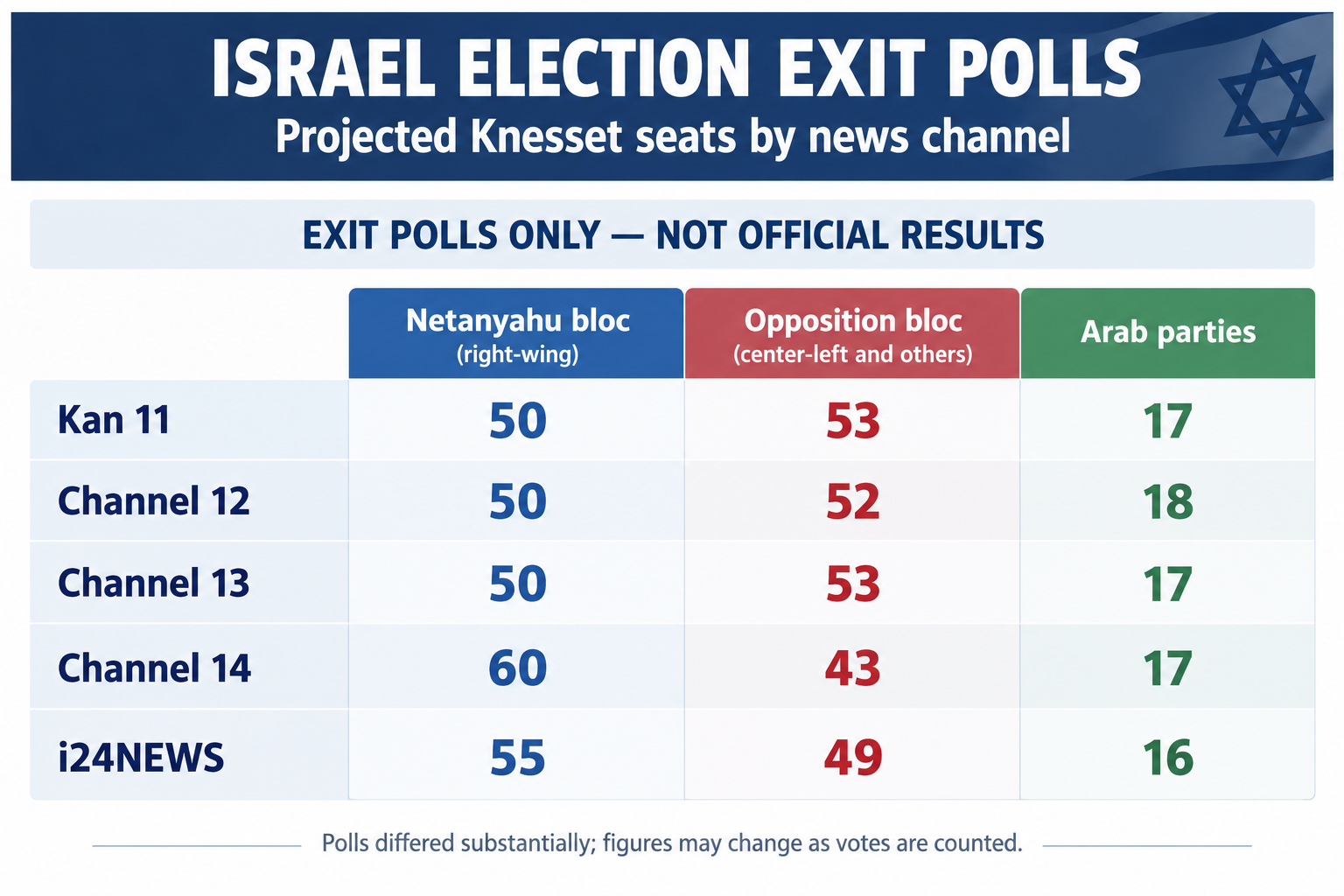
Exit polls released by Channels 11, 12, 13, 14 and i24NEWS differ significantly in their projections. In Israel’s parliamentary system, voters choose a party rather than directly electing a prime minister. The 120 seats in the Knesset, Israel’s parliament, are allocated proportionally, and a government generally needs the support of at least 61 lawmakers to command a majority.
Channel 11 (Kan): Likud, Netanyahu’s right-wing party, is projected to win 25 seats, while Eisenkot’s Yashar is projected to receive 21. Netanyahu’s bloc is projected at 50 seats, compared with 53 for the opposition bloc and 17 for Arab parties.
Channel 12: Likud is projected to win 24 seats and Yashar 22. Netanyahu’s bloc is projected at 50 seats, while the opposition bloc receives 52 and Arab parties 18.
Channel 13: Likud is projected to win 25 seats, Yashar 23 and Naftali Bennett’s B’Yachad party 14. Netanyahu’s bloc is projected at 50 seats, compared with 53 for the opposition bloc and 17 for Arab parties.
Channel 14: Its exit poll offers a notably different projection, giving Likud 30 seats and Yashar 19. It projects 60 seats for Netanyahu’s right-wing bloc, 43 for the opposition bloc and 17 for Arab parties — leaving Netanyahu’s bloc just one seat short of a majority.
i24NEWS: Likud is projected to receive 27 seats and Yashar 20. The poll projects 55 seats for Netanyahu’s bloc, 49 for the opposition bloc and 16 for Arab parties.
The differences are substantial. Channels 11, 12 and 13 put Netanyahu’s bloc at approximately 50 seats, while Channel 14 projects 60. i24NEWS places his bloc between those figures, at 55.
In the three main public and commercial television polls, the opposition bloc has a narrow lead, but neither side reaches the 61 seats needed for a majority. Even if those projections hold, forming a government could prove difficult, particularly because the opposition parties differ over whether and how to cooperate with Arab parties.
These are exit polls only, not official results. They are based on surveys of voters leaving polling stations and can differ from the final count. The actual distribution of seats may change as ballots are counted, particularly for parties close to the electoral threshold.
Historically high turnout, with a surge in Arab communities
Overall turnout reached 74.3% by 8:00 p.m. Israel time, according to the Central Elections Committee — the highest level recorded by that hour since 1988. The figure was well above the 66.3% turnout recorded by the same time during the 2022 election.
Turnout patterns varied considerably between communities. Several Arab cities had already surpassed their final turnout figures from the 2022 election hours before polls closed.
At the same time, several predominantly ultra-Orthodox Jewish cities were recording turnout below their final levels from the previous election.
The turnout gap matters because Israel’s proportional electoral system means that changes in participation can affect how many seats each party wins. The unusually strong participation in Arab communities has been accompanied by exit-poll projections giving Arab-led parties a combined 16 to 18 seats — potentially a record showing. By contrast, lower turnout in several Charedi strongholds could affect the results for parties representing the ultra-Orthodox community. Turnout figures alone, however, do not establish how any community voted.
What happens next?
After the official count is completed, President Isaac Herzog will consult representatives of the elected parties and decide which lawmaker has the best chance of assembling a governing coalition. That candidate will then have a limited period to build a government supported by a majority of the Knesset.
For now, the exit polls offer competing pictures of the election. Likud appears to be the largest individual party in several projections, but the number of seats won by a party is not the same as having enough partners to form a government.
Chabadinfo will update as official vote totals become available.
11
Join ChabadInfo's News Roundup and alerts for the HOTTEST Chabad news and updates!

Related Posts:


Most Popular


New Videos

Editor's Picks