Tefillos for Moshiach Ben Dovid: Shavuos on Mt. Tzion with Dovid Hamelech
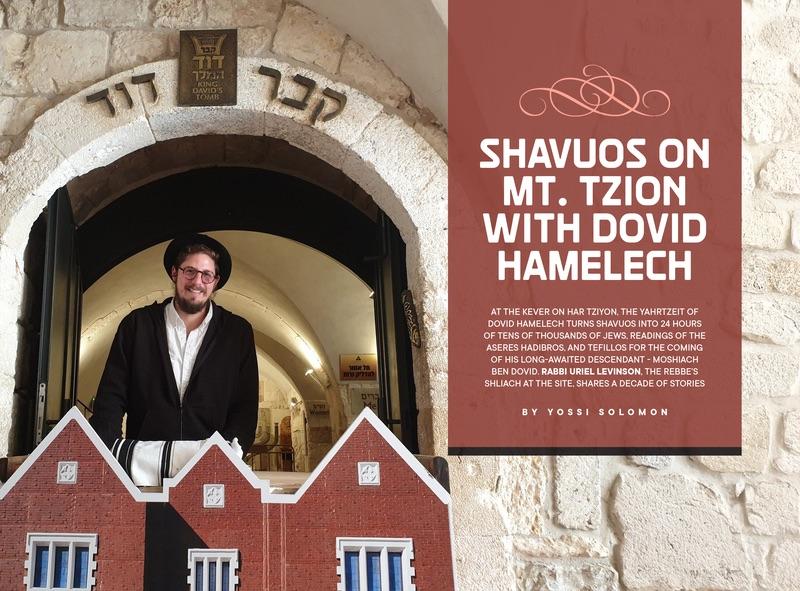
At the Kever on Har Tziyon, the yahrtzeit of Dovid Hamelech turns Shavuos into 24 hours of tens of thousands of Jews, readings of the Aseres Hadibros, and Tefillos for the coming of his long-awaited descendant — Moshiach Ben Dovid. Rabbi Uriel Levinson, the Rebbe’s Shliach at the site, shares a decade of stories • By Yossi Solomon, Beis Moshiach Magazine • Full Article


By Yossi Solomon, Beis Moshiach Magazine
Yerushalayim, the early hours of Shavuos. A festive spirit fills the alleyways of the Old City. A massive human stream, swarms of people, moves toward the spiritual center of gravity: the Kosel. Many thousands pause along the way at the kever of Dovid HaMelech a’h. They remember that this day marks both his birth and his passing.
Among the crowds, one can see someone who stands there throughout the entire year, welcoming the thousands who visit the kever of Dovid HaMelech every day. Meet Rabbi Uriel Levinson, the Rebbe’s shliach at this holy site.
Ahead of Dovid HaMelech’s yahrtzeit, we spoke with Rabbi Levinson, whose year-round activity manages to touch hearts and connect many people to the Rebbe.
How did it all begin? How did you come to this particular shlichus, the kever of Dovid HaMelech?
When I was a bachur in the Ramat Aviv yeshiva, my father and I were offered the opportunity to hold a public Seder at the kever of Dovid HaMelech, and we simply went for it. About fifty guests attended that Seder – most of them homeless, or people with no family or anyone to turn to, who therefore preferred to spend the Seder night with us rather than be alone. That was essentially my first activity at the site.
When I returned to yeshiva after that Seder, I thought to myself: “What about the Seudas Moshiach on Shevii shel Pesach?” I spoke with my chavrusa at the time, Rabbi Sagi Dakal, who to this day assists me in everything to do with the Chabad House. Together we consulted with the mashpia Rabbi Mordechai Weber, who sent us to write to the Rebbe. It was Erev Shevii shel Pesach when we asked the Rebbe about it. I opened a volume of Igros Kodesh to a letter addressed to Rabbi M. Weber and the tmimim… In the letter, the Rebbe speaks about Shavuos as the yahrtzeit of the holy Baal Shem Tov and Dovid HaMelech, and adds that there are people who are held back by constraints of holiness, and that these need to be broken through – and that is the idea of the fifty days.
When we showed the letter to the rosh yeshiva, Rabbi Yossi Ginsburgh, he responded: “If that is the letter the Rebbe wrote to you, you are permitted to go there” – and he even contributed five bottles of wine.
The Seudas Moshiach was a success, with dozens of participants. Since Shevii shel Pesach fell that year on a Friday, we were there for two days – Friday and Shabbos.
One can say that the shlichus at the kever of Dovid Ha’Melech began from that point – recounts Rabbi Uriel Levinson of those early days.
A Room at the Kever of Dovid Ha’Melech
This coming Shavuos will mark ten years since the founding of the “Chabad House at the Kever of Dovid HaMelech.” By the scale of the location, we are talking about thousands of visitors arriving at the complex every single day, including Shabbosos and Yomim Tovim.
Can you share some experiences from the early days of the shlichus?
Like anywhere, in the beginning everything was difficult. In the first years, no one agreed to rent us space within the complex,” recounts R’ Uriel. “It took a long time before the various parties at the kever – the police station, the litvishe Diaspora Yeshiva, and the local residents – agreed to see us as part of the space.
At first, they were wary of Chabad activity on the grounds and of an influence that didn’t match the original character of the place. But as the activity progressed – hospitality for soldiers, the Tzivos Hashem children’s club, welcoming new immigrants and visitors – hearts began to open. People started to see the goodness and the unconditional giving, and the attitude gradually changed.
Did you eventually receive a space for your activities?
“Three years ago,” he recounts excitedly, “the dream came true: we were given a permanent space – the room where the Baba Sali stayed during his visits to the kever of Dovid HaMelech. In the center of the room is a well from which he would wash his hands before going to recite Tehillim. In addition, we were given a second, larger room for our many activities.
“Getting a permanent place was not easy. I remember praying that Hashem would help us receive a space for our work. There was a point where I felt I was close to breaking. From a tefillin stand it is very difficult to build a real program – no Chassidus classes, no children’s activities, nothing.”
At that lowest point, R’ Levinson wrote to the Rebbe asking whether to continue waiting and hoping for a space, or simply to let go. The answer was clear: “Continue your spiritual activities and this will bring about the material reality.”
“From that letter I understood that I needed to keep going, even without comfortable conditions, and the gashmiyus would come when it would come,” says R’ Levinson.
“And indeed, about half a year later, R’ Yishai Yashar Zadeh came to visit us. He is one of the Yaldei Tehran who merited being with the Rebbe after leaving Iran, a close friend of my father’s. When he saw the situation, he personally rented two rooms and gave them to us for the Chabad House.
“Over time, when the owners of the complex – the Diaspora Yeshiva – saw that we were not so ‘scary,’ they finally agreed to rent us the space directly.
“Since then, not only do we have a permanent home, but a warm and open relationship has also developed with the Diaspora Yeshiva and the local families who now regularly participate in our activities.”
What activities do you run there today?
There are daily Torah and Chassidus classes, weekly children’s programs, the Tzivos Hashem club, classes for women given by my wife, Mrs. Shoshana Levinson, and Rabbanit Zohar Dakal, tefillin with the thousands of tourists, and everything needed to ensure that the Rebbe’s light shines anew every day at the kever of Dovid HaMelech.
As part of our day-to-day activity here, we welcome thousands of visitors every day – including tour groups, children’s groups, and even non-Jewish tourists arriving from abroad. In the past year and a half, there has been a wave of reservists arriving for tours of the site. Many of them stop, watch a video of the Rebbe, and some even write to the Rebbe.
One of the projects we run is a project with children in partnership with the Ministry of Education, within the framework of ‘Project Gefen.’ We lead them through an experiential guided tour about Dovid HaMelech and the Davidic dynasty. We then divide the children into two groups – a kind of scavenger hunt – with the final destination being the kever itself, where they sit down, divide the chapters of Tehillim among themselves, and complete the entire sefer within fifteen minutes.
At the end, each child receives a beautiful Sefer Tehillim with a bookmark for the daily Tehillim reading. Many of them keep it for years.
The Peak of Activity — Shavuos
In the HaYom Yom it is written that when Moshiach comes, he will ask us how much we succeeded in influencing others to recite Tehillim on Shabbos Mevorchim.
In the classes we give here, we emphasize the importance of reciting Tehillim every day after davening and on Shabbos Mevorchim. Boruch Hashem, as a result of the classes, there are quite a number of Jews who have committed to recite the entire Sefer Tehillim every Shabbos Mevorchim.
In addition, we launched a special project: in every shul there will be a gabbai whose role is to register the names of those who recite the daily Tehillim on weekdays and on Shabbos Mevorchim, so that we can mention their names at the kever of Dovid HaMelech. I can attest that there is a great demand for this.
But perhaps above all – our central goal is to ensure that as many children as possible come to the kever of Dovid HaMelech, get to know who he was, learn about him, and connect to the recitation of Tehillim. Boruch Hashem, through the Ministry of Education’s ‘Project Gefen,’ we are succeeding in doing this in a very meaningful way.
I understand that Shavuos is one of your peak days of activity…
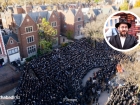
Absolutely! Shavuos is the peak day at the Chabad House at the kever of Dovid HaMelech. It is a sacred time marking the yahrtzeit of Dovid HaMelech and the Baal Shem Tov. Over 48 consecutive hours, tens of thousands of Jews arrive from Israel and around the world. The activity continues from the moment the Yom Tov begins until after Isru Chag.
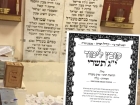
About ten tmimim come from Yeshivas Chassidei Chabad in Tzfas to help out. We operate dozens of booths at the entrances and exits of Har Tziyon, distributing the Rebbe’s sichos about Shavuos, the yahrtzeit of Dovid HaMelech, and the Baal Shem Tov.
This year, through the welcome initiative of the Jerusalem Municipality and the Ministry for Holy Sites, a huge tent has been allocated to the Chabad House, capable of accommodating up to one thousand people. Drinks, baked goods, and popsicles for the children will be distributed in the tent. The space will also be a place for distributing Chassidic material and large-scale hospitality.
Throughout the Yom Tov, readings of the Aseres HaDibros take place – on average once an hour – with hundreds of participants each time. A special performance is held for children who are divided into groups to recite Tehillim.
At the conclusion of the holiday, the yahrtzeit celebration of Dovid HaMelech begins, drawing thousands of Jews from across the country. For the occasion, a special booth is set up for writing to the Rebbe – through which anyone can write a pan and request a bracha.
The following morning, on Isru Chag, members of ‘Kollel Chabad’ arrive, to whom the Rebbe entrusted responsibility for the ‘World Tehillim Center’ at the kever of Dovid HaMelech. They ensure that every day a minyan takes place there for the recitation of Tehillim, as instructed by the Rebbe Rayatz in 1929, to purify the air of the world through the recitation of Tehillim at the kever of Dovid HaMelech.
Here, Souls Are Awakened!
From the above description, it is easy to understand that the complex at the kever of Dovid HaMelech on Har Tziyon welcomes a diverse and fascinating mosaic of Jews from every circle and community, from Israel and from across the entire world, of every age and walk of life.
With so much activity at such a special place, surely there are some fascinating stories you have experienced there…
When non-Jewish tourist groups arrive, we usually gently ask whether anyone in the group is Jewish. On one occasion, no one from the group responded. I tried a different angle: “Does anyone here have Jewish roots?” And suddenly, the priest of the group raised his hand and said that his grandmother on his mother’s side was Jewish…
We explained to him that according to Jewish law, he is also Jewish.
He looked at me in astonishment and said: “Perhaps according to Jewish law I am Jewish, but I am a priest in every sense…”
I spoke with him about the importance of putting on tefillin, so as not to remain in the category of one who never dons tefillin. In the end, after no small amount of persuasion. he agreed to put on tefillin, to the astonishment of his group members, who watched their own priest putting on tefillin…
In a similar story, a priest from Brazil arrived leading a tourist group. He shared that his grandmother on his mother’s side was a Holocaust survivor who was careful not to eat pork, lit Shabbos candles, and observed Pesach. We explained to him that if so, he too is Jewish, and we offered him the opportunity to put on tefillin.
To our great joy, he agreed immediately. And so, forty years after his bar mitzva, he put on tefillin for the first time – here at the kever of Dovid HaMelech.
The following year he returned to visit with another group from Brazil. The second time, he didn’t wait for us to offer him tefillin; he asked on his own… He rolled up his sleeve, put on tefillin, and proudly announced to everyone: “I am Jewish.”
There was another story involving a priest who arrived from Germany, accompanied by nuns. He approached us and said: “I am Jewish.”The difficulty was that he spoke no English, and I struggled to communicate with him. At that very moment, a Breslov Chassid, Rabbi Shraga Brand, who speaks several languages and also operates here regularly, happened to be in the area and it was he who convinced him to put on tefillin.
R’ Levinson adds a hashgacha pratis story:
A few weeks ago, we sat with the Chabad House staff and discussed what mivtzaim would take place in the time of the Geula. Rabbi Sagi Dakal proposed the idea that in the Geula there would be a mivtza tefillin for Rabbeinu Tam tefillin…
A few days later, three observant men arrived here and asked whether we had Rabbeinu Tam tefillin. As it happened, I was not present at that moment and I am the only one who holds Rabbeinu Tam tefillin for mivtzaim, so our volunteer Aharon Idan said there were none available. Rabbi Sagi immediately remarked that we needed to ensure there would always be Rabbeinu Tam tefillin at the complex on a permanent basis.
Five days later, one of the three men returned with a donation of a brand new pair of Rabbeinu Tam tefillin for mivtzaim… Once again we saw how the shluchim make plans and Hashem assists them.
(And in the same breath, he adds): During a Chabad House staff meeting held on Thursday, we realized we urgently needed to order Shabbos candle kits.
The next day, without our having said a word to anyone, a large group of girls from the Chabad women’s seminary in Tzfat arrived at the complex with many Shabbos candle kits. It turned out they had some 2,000 prepared kits remaining and left them with us to use for mivtzaim.
“Look at this,” I said to the volunteers. “We only speak about what we need, and Hashem sends it immediately. If that is so, this is the time to demand Moshiach.”
From Here Shall Come Dovid Our King…
In the Rebbe’s sicha on Parshas Chayei Sarah 5752, the Rebbe stated that the only shlichus now is to prepare the world to welcome Moshiach Tzidkeinu. When one works at the kever of Dovid HaMelech, the meaning of this is sharper and more stirring; to be in the presence of “Dovid Malka Meshicha,” and to pray for the hisgalus of his descendant – “may Ben Dovid Your servant come and redeem us” – in fulfillment of the Divine promise that “his light shall never be extinguished.”
R’ Uriel says: Every person who enters the Chabad House here doesn’t need much explanation; they first see the Rebbe’s portrait, and immediately say, “That is Moshiach.”
These words come from countless visitors even before we say a word. People tell us that they feel how the Rebbe’s great Ahavas Yisrael, his devotion, and his immense spiritual leadership prove to them that he is Melech HaMoshiach.
Classes and discussions on the topics of Geula and Moshiach also take place at the site, including explanations of the Messianic lineage that began with Dovid HaMelech and continues to the Rebbe MH’M.
A young woman came to us once who said she greatly admired the activity of the Rebbe’s shluchim throughout the world but she had difficulty with the belief that the Rebbe is Moshiach. One night she dreamed about the Rebbe. That same day she came here and told us with great emotion that she now understood that the first redeemer is the final redeemer and the Rebbe is Moshiach.
How do you feel the Rebbe’s presence with you in the shlichus?
At every step and in every detail I feel that the Rebbe is with me. Let me tell you two little stories, among many, that will illustrate this:
Recently, I went to pick up my children, but couldn’t find my car keys. I called my wife to update her that I couldn’t find the keys and perhaps she could pick up the children instead of me.
When I returned to the Chabad House to check if I had left the keys there, three religious soldiers suddenly arrived even before I had entered. They told me they were on a tour, their tefillin had been left on the tour bus, and they had no way to get back to it before sunset. They asked if I had tefillin they could use.
Naturally I gave them tefillin to put on. The moment they finished, I suddenly found the keys.
Another story that illustrates the hashgacha pratis in our work: periodically, my fellow shliach Rabbi Sagi Dakal and I write a progress report to the Rebbe.
More than once, when we opened the Igros Kodesh, we saw a response in which the Rebbe speaks about opening a yeshiva. We understood that the Rebbe wanted us to open a yeshiva, but didn’t believe we could finance such a project, which requires enormous financial resources we didn’t have.
A few days after we signed the lease for the Chabad House, I received a phone call from a man who introduced himself as Yehuda, from a Chabad educational network. He said they were looking for a space near the kever of Dovid HaMelech in order to establish a yeshiva for young Americans, and asked whether they could use one of the rooms in the Chabad House. Naturally I was happy to oblige.
Today, the Yeshiva ‘Tomchei Tmimim’ at the kever of Dovid HaMelech operates here. It’s a full-fledged Chabad yeshiva which also engages extensively in mivtza tefillin and additional mivtzaim with the soldiers who come to the area.
In practice, the Rebbe’s instruction is being fulfilled. I can attest that thanks to the bachurim, the shlichus has expanded to dimensions we never anticipated.
So yes, I feel that the Rebbe accompanies me at every moment, in every detail of the avodas ha’shlichus.
In conclusion, as it is close to Shavuos and the yahrtzeit of Dovid HaMelech, what is your message to readers?
That people, especially children, should come and visit the kever of Dovid HaMelech.
As is known, before the Six Day War, and especially before the Yom Kippur War, the Rebbe called for gathering Jewish children for a rally of tefilla and hisorerus, in the spirit of ‘silencing the enemy and avenger.’ In times like these, we need the prayers of children more than ever, for the success of the war against Israel’s enemies.
From here I also direct an additional call: that people should ensure that in their shul there is a designated person whose role is to register the names of those who recite Tehillim, both the daily portion and on Shabbos Mevorchim, and we will mention their names at the kever of Dovid HaMelech for a yeshua in all that is needed, twice a year: on Hoshana Raba and on Shavuos. Both of these occasions are especially propitious for the recitation of Tehillim and for requesting yeshuos.
Our task is to pray and petition for the hisgalus of Dovid Malka Meshicha, in the true and complete Geula – and there is no more fitting place for this than the kever of Dovid HaMelech, especially on Shavuos – to pray, to cry out, and to live with the Geula. For we pray “and saviors shall ascend Har Tziyon to judge the mount of Esav,” and we are, after all, on Har Tziyon…”
***
Beis Moshiach magazine can be obtained in stores around Crown Heights. To purchase a subscription, please go to: bmoshiach.org
103
Join ChabadInfo's News Roundup and alerts for the HOTTEST Chabad news and updates!

Related Posts:


Most Popular


New Videos

Editor's Picks