A Ketzos in One Hand, A Tanya in the Other
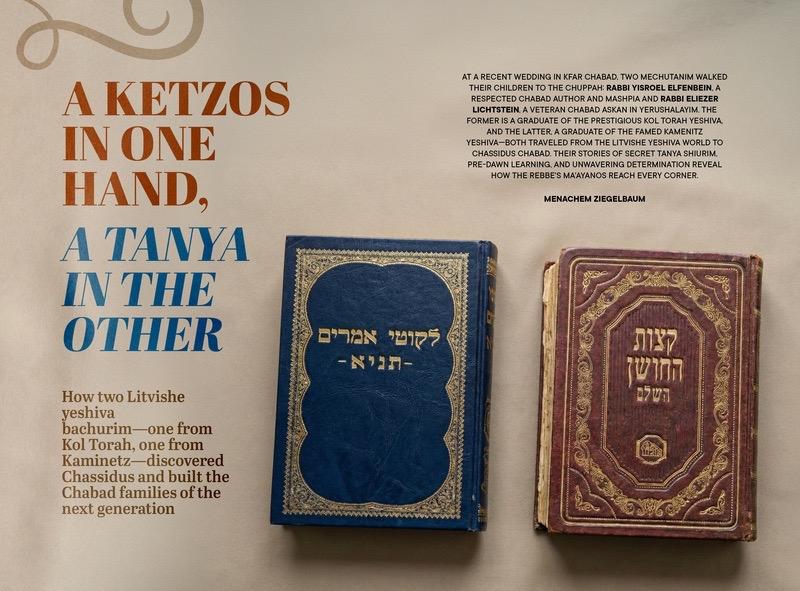
From Beis Moshiach Magazine: At a recent wedding in Kfar Chabad, two mechutanim walked their children to the chuppah: Rabbi Yisroel Elfenbein, a respected Chabad author and mashpia, and Rabbi Eliezer Lichtstein, a veteran Chabad askan in Yerushalayim. The former is a graduate of the prestigious Kol Torah Yeshiva, and the latter, a graduate of the famed Kamenitz Yeshiva—both traveled from the Litvishe yeshiva world to Chassidus Chabad. Their stories of secret Tanya shiurim, pre-dawn learning, and unwavering determination reveal how the Rebbe’s ma’ayanos reach every corner • Full Article


By Menachem Ziegelbaum, Beis Moshiach magazine
• Beis Moshiach magazine can be purchased in Crown Heights stores. To purchase a subscription, please go to: bmoshiach.org
Dozens of family members, from both sides of the families, stood in their Shabbos and Yom Tov attire at the chuppa that was festively erected in Kfar Chabad, watching the two fathers make their way to the chuppa – one hand holding the chassan, the other holding a flaming candle. The chassan’s head was bowed, and the fathers went out to greet the kalla as she made her way to the chuppa.
Over the years, the two fathers established well-known families in Chabad in Eretz Yisrael. One is Rabbi Yisroel Elfenbein, rabbi of the Chabad shul on Rechov Smilansky in Netanya, a maggid shiur at the Chabad Lubavitch Yeshiva in Tzfas, and formerly a maggid shiur and mashpia at Tomchei Tmimim of Netanya. He is also known for his prolific writing in the world of Chabad literature.
On the other side stood the kalla’s father – Rabbi Eliezer Lichtstein, a veteran educator, one of the prominent Chabad activists in Yerushalayim who spent many years coordinating the Rebbe’s broadcasts throughout the country, and merited being the “channel” through which tens of thousands of responses and answers from the Rebbe passed to all Anash in Eretz Yisrael.
In both families, each in its own way, they made their way to Chabad Chassidus through recognizing the sweetness of Chassidic teachings. Now, erev Chag HaChagim, Yud-Tes Kislev, is the appropriate time to tell the story of these two who made their way to Toras HaChassidus, each in his own way.
The Mashgiach’s Rebuke In Front of All the Students
We begin with the story of the mechutan from the chassan’s side, Rabbi Yisroel. His father, Rabbi Mordechai Tzvi a’h Elfenbein, studied in his youth at the Litvishe yeshiva Kol Torah, and was one of the outstanding bachurim. At a certain point, his friend Rabbi Yaakov Horowitz persuaded him to join the underground Tanya class given by the mashpia, Rabbi Yosef Tzvi Segal at Kol Torah, where both studied. Many serious bachurim in those years were seeking spiritual chizuk and a path in avodas Hashem. When he heard that through Tanya classes one acquires a special derech that brings additional chayus in serving Hashem, he decided to try it out.
Over time, he tasted the flavor of Toras Chabad and decided to draw closer to Chassidus itself. He was not satisfied until he influenced additional friends in the yeshiva to join the Tanya shiur.
Rabbi Menachem Wolpo, the Rebbe’s shliach in Netanya who also studied at Yeshivas Kol Torah, later recounted that the bachur, Mordechai Tzvi Elfenbein, would repeat the Rebbe’s sichos to the students in the dining room – sichos explaining Rashi’s pirush on the Torah. He would not allow any of the bachurim to interrupt him in the middle of the sicha and demanded that they listen to the explanation until the end…
One day, Mordechai Tzvi was summoned to the mashgiach of the yeshiva in the middle of seder, and he was rebuked in front of everyone for influencing his friends to study Tanya and Chassidus… The bachurim stared and the scene was uncomfortable. When Mordechai Tzvi returned to his place, his chavrusa, Baruch Lesches (now rav of the Chabad community in Monsey) asked him: “Nu, and what will you do now?” Mordechai Tzvi replied by quoting the pasuk, hinting at himself: “And Mordechai would not bow and would not prostrate himself!…”
One of his friends from that period, Rabbi Chaim Kornberg a’h (later one of the roshei yeshiva of the Gur Yeshiva in Tel Aviv), related years later that when Mordechai Tzvi was in shiur alef of yeshiva gedola, he – R’ Chaim – was still in yeshiva ketana. They would wake up every day four in the morning and study Ketzos HaChoshen together for one hour and Tanya for an hour… Over time, R’ Chaim moved the clock forward a bit at the end of the Ketzos study, so they would study Tanya longer… Such was his desire to study Chassidus.
Years later, Rabbi Yosef Tzvi Segal recounted about his talmid Mordechai Tzvi: “Before Yud-Tes Kislev 5726 (1965), I sent a group of bachurim from Yeshivas Kol Torah to a farbrengen in Kfar Chabad. I arranged for them to be there from Thursday night until motzoei Shabbos. Beforehand, I sent a message to the bachurim in Kfar Chabad: ‘This time serious chevra are coming, like Elfenbein and Lesches, and you need to grab them…’
“The tmimim indeed did their work faithfully, and when Mordechai Tzvi returned from Kfar Chabad, he told me: ‘I was very impressed by the yeshiva, both in Nigleh and in Chassidus. Everything found favor in my eyes, both in terms of yiras shomayim and the atmosphere, and I want to transfer to learn in Kfar Chabad.’
“I told him: Please enumerate for me the maalos (good points) you found in the yeshiva. He began to detail the virtues and advantages, adding several examples for each point.
“At this point, I told him: ‘And now please enumerate before me the shortcomings you found there.’ He reacted: ‘What do you mean? There are no shortcomings there!’ I told him: ‘That cannot be; there is no yeshiva that has no shortcomings. If so, you must wait until you also recognize the shortcomings of the yeshiva, and then decide…’
“Before Yud Shevat, I sent him again to the yeshiva. When he returned, I saw that he no longer reacted with the same enthusiasm as the previous time, after Yud-Tes Kislev. He admitted to me that this time he also found shortcomings there, and detailed five shortcomings to me. I proved to him that two of the five were indeed correct (when the mashpia farbrengs, not everyone listens to him, and also regarding the number of bachurim who get up early for the Chassidus seder on Shabbos morning), and three were not correct. He said he would weigh the virtues against the shortcomings and then decide. He deliberated for a long time, and after several months decided to transfer to Kfar Chabad nevertheless,” concludes Rabbi Yosef Tzvi Segal’s account of R’ Elfenbein’s becoming involved with Chassidus from his perspective.
‘When You Begin to Understand a Little Chassidus, All Doubts Disappear’
At the beginning of summer 5726, a few weeks after entering the yeshiva, Mordechai Tzvi Elfenbein wrote letters to Rabbi Yosef Segal describing his feelings upon entering the Chabad yeshiva. From the letter, it emerges that Rabbi Segal tried to moderate his student’s enthusiasm and asked him not to immediately start learning three hours of Chassidus every day, as is customary in Tomchei Tmimim: “To my teacher Rabbi Yosef Segal… Regarding Chassidus [whether to study only in the morning Chassidus seder or also at night], of course I first asked Reb Shlomo Chaim, and I don’t understand why you are afraid. Is it not enough for me the years I didn’t study Chassidus until now?! It seems to me there is no mitzva to add to them…”
From another letter written at the end of Iyar 5726, his longing for Chassidus emerges:
“All the doubts I had regarding Chassidus no longer exist. When one begins to understand a little Chassidus, even just a taste, all doubts automatically disappear. And it astonishes me what pains them, all those who oppose Chassidus. Why don’t they try to taste the flavor of Chassidus for a few months? Perhaps it is something after all?! Apparently, fear grips them at the thought of becoming Chassidim… I imagine that there has never been anyone who studied Chassidus and remained a misnaged. It is possible he did not become a Chassid, but a misnaged – that he certainly did not remain. Now one only needs to begin working so that Chabad [intellect] will truly be a source for middos [emotions].”
It appears that the student Mordechai Tzvi fell in love with the study of Chassidus to such an extent that the mashpia, Reb Shlomo Chaim gently rebuked him, as he himself related in his letter: “Today Reb Shlomo Chaim wanted to encourage me when I asked a question during a shiur he gave us on ‘Hemshech 5666,’ and he told me that if I would say such good logical arguments in Nigleh as the arguments I say in Chassidus, it would be wonderful…”
‘They Wake Up Very Early in the Morning and Go to Learn Several Hours of Chassidus’
Another student who studied at Yeshivas Kol Torah and came to know Chabad teachings from there is Rabbi Shabtai Slavaticki, later the Rebbe’s shliach in Antwerp, Belgium.
During that period, he came from the yeshiva in Yerushalayim to the Yud-Tes Kislev farbrengen in Kfar Chabad. In the middle of the farbrengen, one of the bachurim was moved by the words of the mashpia, Reb Shlomo Chaim and burst into tears. The mashpia, seeing this, was not impressed and said the bachur deserved a “mashkanta” (mortgage/rebuke)…
R’ Shabtai, who had only begun to draw close to the ways of Chabad Chassidus and was not familiar with its ways, did not understand what was wrong with the bachur’s behavior – on the contrary, he should be praised for it… Mordechai Tzvi Elfenbein, who sat next to him, patiently explained to him the pnimiyus of Chassidus: “If you want to cry, fine. But why must you do so in front of everyone? You want to show everyone that you are on a higher level than them, that they are not as moved as to cry, and you are moved…”
At the conclusion of his learning in the yeshiva, Mordechai Tzvi went for his ‘Kevutza’ year to the Rebbe. He stayed there from Nissan 5728 until Nissan 5729.
Twenty-two years later, before his son R’ Yisroel went on ‘Kevutza,’ the father wished to guide him in the proper way and even gave him ‘warnings’ – from which his son could conclude what his father had done during his time during his Kevutza year. And so he warned his son – warnings that require study: “You certainly know what it looks like there. They wake up very early in the morning, go to learn several hours of Chassidus, daven at length, and after davening hurry to eat something to be able to arrive on time for the Nigleh seder. So try to maintain your health, and be sure to eat properly…”
One of his friends from those glorious days, Rabbi Eliyahu Suissa of Kiryat Gat, relates that Mordechai Tzvi was present in the zal throughout the day without interruption, even on days and at hours when the zal was almost empty.
The mashpia, Rabbi Shlomo Zarchi, also later recounted: “Mordechai Tzvi, during his time on Kevutza, would wake up at four in the morning and go to the zal to learn Chassidus several hours before the davening…”
Thanks to his abilities and tremendous diligence, he merited being one of the seven ‘kannim’ in Nigleh at the central Tomchei Tmimim Yeshiva 770, and after his passing, his sons had this engraved on his matzeiva.
Over the years, he told his son Yisroel how the bachurim rushed to conduct the Pesach Seder and then hurried to the Rebbe’s Seder. Thus he merited being present at four Seder nights with the Rebbe, two in 5728 and two in 5729, standing at the Sedarim in a place very close to the Rebbe, following every movement of the Rebbe.
Years later, he would describe various details he saw with his own eyes. For example, how the Rebbe sprinkled a very large amount of salt on the piece of fish on his plate until from above no fish was visible at all, only salt, and the Rebbe ate this. He also described how the Rebbe ‘squeezed’ an amount of white horseradish the size of an average egg and placed it for the simanim for ‘maror’ and ‘chazeres.’
The Connection Between Mikva and Joy
Rabbi Mordechai Tzvi established a beautiful Chassidishe family, involved in Torah and Chassidus.
His son, R’ Yisroel, studied in his childhood years in Chabad schools (see sidebar), but at a certain point ‘skipped’ two grades in elementary school. Upon completing eighth grade, he was tested to enter the yeshiva ketana in Lod, and even passed the test, but the rosh yeshiva announced that despite his doing well, he could not accept him due to his young age (11 years old).
And so, following a chain of various events, young Yisroel transferred to learn in ‘HaYishuv HeChadash’ in Tel Aviv. Throughout that entire period, he endeavored to maintain the Chabad connection, including studying Chassidus on Shabbos and other times.
“At the end of winter (5746), our family moved to Bnei Brak, where we davened at the Chabad shul at 26 Rechov Rashi,” related R’ Elfenbein. “During the bein ha’zmanim of Menachem Av 5746, Yaakov Orenstein suggested I study Chassidus with him every evening. I agreed. We studied ‘Shaar HaYichud VeHaEmunah’ at a deep level (the learning was based on the Rebbe’s sichos and the explanations of Reb Yoel Kahan), and this made a tremendous impression on me. Although I continued to study at the Yeshivas HaYishuv, I realized that Chassidic teachings are something serious and deep that I must get to know.
“Another important milestone that I remember well was on Shabbos Parshas Shelach, 24 Sivan 5747. After finishing the Shabbos day meal, I went back to the Chabad shul on Rechov Rashi. The Chassid Reb Dovid Goldstein a’h was still sitting there, at the end of the farbrengen. When he saw me, he began a long conversation with me that lasted several hours. Among other things, he told me that I looked sad, and explained to me that if I begin going to the mikva every day, this would cause me joy.
“I asked him what the connection was between these things, and he replied with the famous saying of the tzaddik Rabbi Aharon of Karlin: ‘Mikva is not a mitzva, and sadness is not a sin but what mikva can bring – no mitzva can bring. And what sadness can lead to – no sin can lead to…’ R’ Dovid concluded that mikva is the antithesis of sadness… He explained that when a young man suffers from foreign thoughts, etc., this defiles his G-dly soul, and therefore it is sad. Immersion in the mikva purifies his G-dly soul, and consequently it is joyful.
“I accepted his advice, and it seems this indeed helped me to additional joy…
“At the end of the 5748, the Rosh Yeshiva of ‘HaYishuv HeChadash,’ HaGaon Rav Y. Kolodetzky zt’l, held a farewell conversation with me. During that conversation, he told me about a letter he once received from the Rebbe before Shavuos, in which appeared the wish ‘to receive the Torah with joy and pnimiyus.’ ‘I understand what the meaning of studying Torah with joy is,’ he said, ‘but what is the meaning of studying Torah with pnimiyus? Is it possible to study Torah with chitzoniyus?’
“As is my way in such cases – when I did not have a ready answer regarding Chabad matters – I promised him to find an answer. The next day I returned to him with a photocopy of a sicha from ‘Likkutei Sichos’ volume 4 page 1307, in which the Rebbe explains the matter. As was his way always, he was not satisfied with receiving the photocopy but asked to hear the clarification from me in my own words. I needed to clarify the matters well with a Chabad Chassid in Bnei Brak, in order to get back to him with a satisfactory answer…”
The Rebbe Looked at Me with a Strong and Special Gaze
“My first Tishrei with the Rebbe was Tishrei 5749 (1988). One of my good friends told me with conviction that Tishrei: A bachur who travels to the Rebbe once for Tishrei will not be able to give up any Tishrei with the Rebbe from then on. At the time I was skeptical about this, but the fact is that since then I was there for Tishrei in 5750, 5751, 5752, and 5753 (in Sivan 5753 I got married, and as a married man I traveled once every few years).
“On the night leading into Rosh Chodesh Marcheshvan 5749, a yechidus was held for the talmidei ha’tmimim. I prepared as they taught me to prepare – fasting during the day, going to the mikva again before the yechidus, writing a pidyon nefesh seriously, and going in with a gartel under the suit. In that pidyon nefesh, I wrote to the Rebbe that I accept upon myself to learn in Yeshivas Tomchei Tmimim on a regular basis.
“After the yechidus, when I passed before the Rebbe and handed him the pan, the Rebbe gave me the dollar and looked at me with a strong and special gaze, which is engraved in my memory to this very day. I felt as if the Rebbe was ‘affirming’ with this gaze that he received my notification about entering Tomchei Tmimim.
“At the farbrengen of Shabbos Parshas Toldos 5749, one of my first Shabbosos in the yeshiva, the mashpia, Reb Zalman Gopin asked me: What are you called – ‘ah geborener Chassid’ (someone born a Chassid) or ‘ah gevorener Chassid’ [one who became a Chassid]?
“Before I had a chance to respond to his question, the mashpia explained to all the bachurim what the virtues and shortcomings of each of them are:
“The virtue of ‘ah geborener Chassid’ is that he is familiar with all the ways and customs of Chassidim and practices them as one experienced and accustomed to them. He knows the ideas of Chassidus and the pathways of Chassidic teachings are clear to him. His shortcoming is that he lacks the warmth, hischadshus, and enthusiasm of those who have recently arrived.
“The virtue of ‘ah gevorener Chassid’ is that he experiences everything with excitement and enthusiasm, because the things are new for him. He absorbs every idea with zest and is happy for the zechus of having come to know these wonderful things. His shortcoming is that it takes him time until he absorbs the matters properly and deeply.
“And then, R’ Zalman himself told me the answer: You are both a ‘geborener’ and a ‘gevorener.’ The choice remains with you whether to adopt for yourself the virtues of both, or the shortcomings of both…
“In my personal diary, I wrote on the motzoei of that Shabbos that I decide, with Hashem’s help, to adopt both virtues, and I noted for myself a good resolution: ‘To endeavor in actual practice in proper tefilla that brings to love and fear – although these are matters not on my level – and to be careful to avoid pride and self-importance.’”
Roots in the Lithuanian Torah World
As mentioned, the other side of the wedding was the kalla’s father, Rabbi Eliezer Lichtstein. R’ Lichtstein also made his own long journey to Toras Chabad, until he became one of the ‘familiar faces’ in the Chabad community in Eretz Yisrael, in Yerushalyim in particular.
R’ Lichtstein’s roots are from the Litvishe world in previous generations. His great-grandfather was the Rosh Yeshiva of Kamenitz, the Gaon Rabbi Baruch Ber Leibowitz, author of the Birkas Shmuel, who was a distinguished talmid of the Gaon Rabbi Chaim of Brisk. He had tremendous bittul before him.
R’ Lichtstein himself learned in Yeshivas Kamenitz, headed by his father, the Gaon Rabbi Asher Lichtstein. “In the yeshiva there were several bachurim who became Gerrer Chassidim, and I saw that following the ways of Chassidus influenced them for the good,” he later related. “They became stronger in yiras shomayim and improved in all spiritual matters. Following this, I began to be drawn in the general direction of the world of Chassidus, and when I was about 17, I spent about a year basking in the light of the Admor, the Beis Yisroel zt’l of Gur.
“One of my friends, R’ Chaim Yosef Weisfish (now of Chabad in the Ramat Shlomo neighborhood of Yerushalayim), who until then studied at Yeshivas Chevron, began studying Tanya with Rabbi Yosef Tzvi Segal and drew close to Chabad Chassidus and then asked to transfer to learn in Tomchei Tmimim. Rabbi Segal suggested he spend another half year at Yeshivas Kamenitz, and only afterward transfer to learn at Tomchei Tmimim.”
On the shelf of sifrei mussar in the Beis Medrash in Kamenitz were five large Tanyas that had been purchased previously from Reb Zusha Wilyamowsky a’h. The latter used to visit various yeshivos and offer them sefarim for sale, in Nigleh and in Chassidus.
Eliezer Lichtstein and his friend Yosef Meir Strasberg began studying Tanya together every evening during the mussar seder. Subsequently, they began attending Tanya classes held at Rabbi Segal’s home. “The shiur was very appealing to us, and since then my connection with Chabad grew stronger,” relates R’ Eliezer Lichtstein.
The first time he attended a farbrengen was at Yeshivas Toras Emes, on the night of Yud Kislev 5729, the Chag HaGeula of the Mitteler Rebbe. The farbrengen was held with Rabbi Yosef Tzvi Segal, who then served as mashpia at the yeshiva.
“Following the farbrengen, we wrote to the Rebbe – I, Yosef Meir Strasberg, and another bachur from Yeshivas Kamenitz. We requested a bracha from the Rebbe,” recalls R’ Lichtstein. “We all wrote on one airmail letter, on one page, and each of us saw what the others wrote.
“About two weeks later, the Rebbe answered each of the three of us in a separate letter. With the third bachur there was an addition at the end of the letter: ‘Surely you keep the three fixed shiurim of Chitas.’ It turned out he still wasn’t learning Chitas; we had indeed already begun learning Chitas, but we did not mention this in the letter. When the third bachur noticed the difference between the letters, he could not help but be amazed at the Rebbe’s ruach ha’kodesh.”
A Chassidus Class at Five in the Morning
“One year, on the night of Beis Nissan, the yahrtzeit of the Rebbe Rashab, one of the bachurim told me that tonight there would be a farbrengen with the mashpia R’ Shlomo Chaim Kesselman at the yeshiva in Kfar Chabad. He suggested I travel with him to the farbrengen. I agreed and we traveled together to Kfar Chabad.
“The farbrengen was very moving and special. The bachurim there also made a strong impression on us, like Chaim Shlomo Cohen, Aryeh Leib Kaplan (now in Montreal), and others. Toward morning we left Kfar Chabad back to Yerushalayim, and we made it by seven in the morning for Shacharis in the yeshiva. Everything was done secretly.
“After that, once every two weeks I would travel on Thursday night to Kfar Chabad. The bachur, Shalom Ber Wolpo suggested I approach Reb Chaim Shalom Deutsch in Yerushalayim and build a connection with him, and so I did. After that, Reb Chaim Shalom would come to one of the Sefardic shuls near Yeshivas Kamenitz twice a week and learn Chassidus with me and Yosef Meir Strasberg. The shiur was at five in the morning, so we would make it for Shacharis at seven at the yeshiva. We began studying from the beginning of the sefer Shaarei Orah of the Mittler Rebbe.
“One day I told Rabbi Deutsch that I intended to write a letter to the Rebbe requesting a bracha, and he asked that I mention him too in the letter, ‘Chaim Shalom ben Miriam,’ and thus the Rebbe would think about him for another second…
“Since then, every time I mention someone in a letter to the Rebbe, I try to note their full name and their mother’s name.”
‘I Heard You Became a Chabadnik’
“At the end of the winter 5730, the Gaon Rabbi Yaakov Moshe Leizerson arrived in Eretz Yisrael. He was an alumnus of Yeshivas Mir and one of the maggidei shiur in Torah Vodaas in Brooklyn. He had drawn close in those days to the Rebbe, and through him to Chabad Chassidus.
“One day Rabbi Leizerson came to visit my parents’ home. When he saw me, he patted my shoulder and said: ‘I heard you became a Chabadnik.’ I answered in the affirmative and he said to me: ‘Tell me what is written in today’s shiur Tanya.” I immediately told him the content of the day’s Chitas portion, and he remarked: “Good, I see you are really a Chabadnik…”
“On one of the subsequent nights, I organized a Chassidishe farbrengen with him in his room where he was staying. In addition to me and Yosef Meir, about five more bachurim from Yeshivas Kamenitz were present at the farbrengen. It was a very interesting farbrengen, with words of Chassidic inspiration and Chabad niggunim. Needless to say, all this was done secretly, without the hanhala of Yeshivas Kamenitz knowing about it.
“Rabbi Leizerson reported this to the Rebbe, and following this we merited receiving from the Rebbe the following letter (Igros Kodesh volume 26 page 102):
“B”H, 2 Nissan 5730 Brooklyn, N.Y.
“To the avreichim ha’talmidim who participated in the farbrengen of the honorable etc. who engages in communal needs, whose work is the work of Heaven, the Chassid Rabbi Yaakov Moshe Leizerson
“May Hashem be upon them, may they live
Shalom and Blessing!
“It was pleasant for me to receive regards from them through the Chassid etc. R’ Y.M., who also informed me about the farbrengen and the conversation with divrei Torah and yiras shomayim etc.
“And may it be Hashem’s will that Hashem’s desire will succeed in their hands to increase Torah and glorify it, both regarding themselves and regarding spreading the study of our holy Torah, the Torah of life, the revealed and the inner, wherever the hand of each and every one of them reaches…”
The Beis Din’s Decision: With the Parents’ Consent
“In the summer of 5730, I began going regularly to all the farbrengens held at Yeshivas Toras Emes. At that stage, I was already ripe to transfer to study at Toras Emes, but my parents did not agree to this, especially since my father himself served as Rosh Yeshiva of Kamenitz where I learned.
“I asked the Rebbe about this and the Rebbe answered: ‘I will mention it at the tziyun.’ Afterward I spoke by telephone with Rabbi Chodakov and he told me: ‘This is an explicit halacha in the Shulchan Aruch, that a person must study ‘in a place where his heart desires.’”
Rabbi Chodakov quoted to me the Rebbe’s well-known question: Why does this halacha appear in the Laws of Kibud Av, and not in the Laws of Talmud Torah? After all, apparently this is a halacha stemming from a certain maalah in Torah study. Rather, the Rebbe explains – that when a person does not listen to his father and goes to study in a place where he will succeed more in his studies, in this he fulfills the mitzva of honoring father in its true sense…
“My father himself tried to contact Chabad people he knew, so they would influence me not to leave his yeshiva. He turned to Rabbi Chaim Meir Bukiet, one of the heads of Yeshivas Tomchei Tmimim in New York, whom my father knew from the period when talmidim of Tomchei Tmimim were alongside talmidim of Yeshivas Mir in Shanghai.
“He also contacted Rabbi Eliyahu Quint, one of the Rebbe’s secretaries, who belonged to Litvishe circles and was then visiting Eretz Yisrael.
“One day in 5731, Rabbi Tuvia Blau came to me and suggested I go to Rabbi Zelig Slonim to consult with him regarding my place of learning.
“At first, I was not thrilled with the idea, and I did not go. A few days later, Rabbi Blau came to me again and recommended again that I approach R’ Zelig. Finally, I went to R’ Zelig and he suggested convening a Beis Din at Rabbi Shlomo Yosef Zevin zt’l’s home and discussing the matter… I agreed.
“The three who gathered at Rabbi Zevin’s home were: Rabbi Zevin himself, Rabbi Zelig Slonim, and Rabbi Shmuel Elazar Halperin a’h. They invited me to come, and I went (I knew the house well. I remembered how my father would go at the beginning of each new zman at the yeshiva to Rabbi Zevin’s home to borrow sefarim on the new mesechta they began learning. Rabbi Zevin’s home was full of bookcases, and he would climb the ladder himself and bring down the requested sefarim for him):
“The Beis Din listened to me and afterward announced to me – and later also to the Rebbe – that they decided I should go to study at Yeshivas Toras Emes only during the Chassidus sedarim in the mornings and evenings, and even this, on condition that it be done with clear knowledge that my parents agree to this.
“So it was. I asked my parents to agree to my request regarding daily attendance at the Chassidus sedarim at Yeshivas Toras Emes. My parents agreed, and I went to Toras Emes twice every day to learn Chassidus, with a Chassidus seder in the morning and a Chassidus seder in the evening.
“At that stage, I was not supposed to know that an explicit instruction had come from the Rebbe to R’ Zelig that he should speak with me about this. I only learned of this at a much later point, from some of the bachurim at Toras Emes who eventually told me that R’ Tuvia had pressured them to influence me – ostensibly on their own initiative – to consult with R’ Zelig, since this was an instruction that had been received from the Rebbe…
“In the summer of 5732, the Rebbe sent copies of the Tanya for distribution to the talmidim of Toras Emes. The yeshiva hanhala decided that I too deserved a copy, even though I was not a regular talmid at the yeshiva. Rabbi Zelig Feldman explained to me on behalf of the hanhala: ‘The Baal Shem Tov said that “where a person’s will is – there he is found,” and since you want to be at Toras Emes, you too deserve to receive one.’
“In the following years, I would occasionally bring young men from Litvishe yeshivas to participate in the farbrengens of the mashpia, Reb Mendel Futerfas a’h in Kfar Chabad. Sometimes I would bring them to visit Reb Mendel’s home. His wife would prepare hot soup for them, and the mashpia himself would personally serve them the soup… They were very impressed by his simplicity.
Once he said to me regarding the drawing close to Chassidus of the bachur, Avrohom Cohen a’h, who learned in Yeshivas Chevron (and later became one of the Rebbe’s shluchim in Beer Sheva): “If you learn Chassidus with him, then from your ‘shtein’ [stone] will be made ‘licht’ [light]. And if not, then from your ‘licht’ [light] will be made ‘shtein’ [stone]…”
***
“HERE SAT THE BAAL SHEM TOV, AND HERE SAT THE MAGGID…”
Rabbi Yisroel Elfenbein tells of one of his Chassidic childhood experiences that was deeply engraved in his soul:
“In the years 5738 and 5739 (1978-1979), I studied with the Chassidishe melamed Rabbi Shalom Dovber Kesselman a’h, to whom I credit my inner spiritual identification with Chabad Chassidus. As a true pnimi, he planted in us Chassidic values that penetrated deep into my soul.
“Every day he would read before us the daily section in ‘HaYom Yom’ (in those years this had not yet become an accepted practice). After the Rebbe’s farbrengens, he would review portions of the farbrengen for us, and on various occasions he would tell us Chassidic stories.
“Once he told us the well-known story that the Rebbe Rashab asked his son, the Rebbe Rayatz, about a certain night vision he had: ‘What do you remember?’ And the Rebbe Rayatz described a certain scene in detail. The Rebbe Rashab explained to him what he saw in the vision: The man sitting at the head of the table was the Baal Shem Tov, on one side sat his student the Maggid of Mezeritch, and on the other side sat the Alter Rebbe. And in other places sat several more of our Rebbes, leaders, and their sons, etc., and around them sat the talmidim.
“The melamed, Rabbi Kesselman wanted to illustrate this for us and seated all the children in the class in an appropriate formation. I, whose name is Yisroel, sat in the place where the Baal Shem Tov sat. My friend, whose name was Dovber (Levitin), sat in the place where the Maggid sat. Another friend, whose name was Shneur Zalman (Chanzin), sat in the place where the Alter Rebbe sat. And so on. Each of the children was asked to read from the sefer the ‘Torah’ that the Rebbe he represented said, and so forth. This scene, which took place in our classroom that was then located in the women’s section of the old shul in the Chabad neighborhood in Lod, is deeply engraved in my memory.”
191
Join ChabadInfo's News Roundup and alerts for the HOTTEST Chabad news and updates!

Related Posts:


Most Popular

New Videos

Editor's Picks