



HaMaor: The Journal That Brought the Rebbe to the American Rabbinate
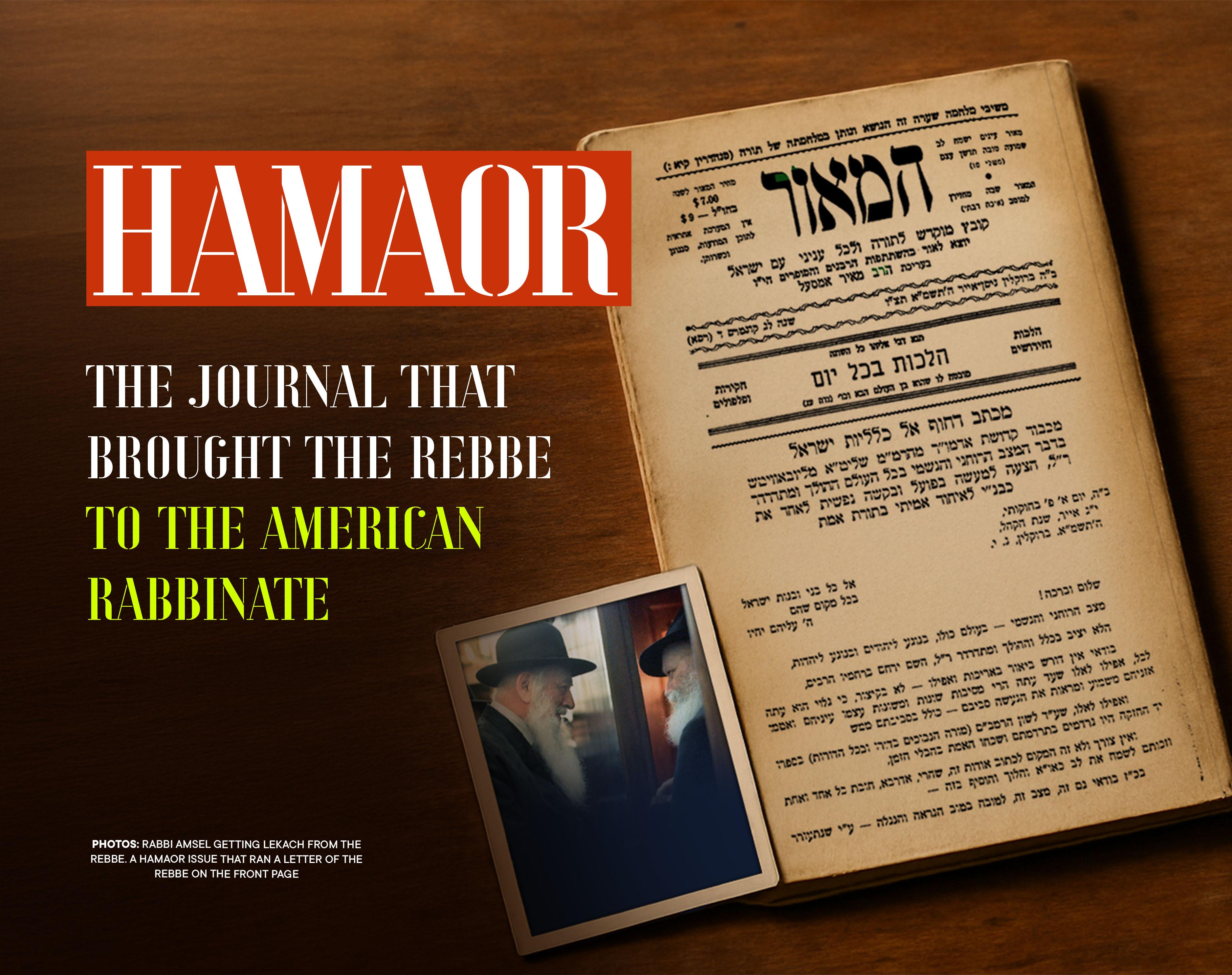
Since its first edition appeared in 5710, Rabbi Meir Amsel’s HaMaor journal served as a bridge between the Rebbe MH”M and America’s Torah elite and evolved into something far more significant—the primary vehicle through which the Rebbe’s teachings reached rabbis, roshei yeshiva, and Torah scholars across the United States. This is how one devoted publisher selflessly turned his journal into Chabad’s most influential platform in the American rabbinical world. From personally edited sichos that the Rebbe prepared specifically for HaMaor’s scholarly readership, to fearless advocacy during controversial moments – Rabbi Amsel’s unwavering dedication created a unique conduit that forever changed how Orthodox America viewed the Rebbe and his revolutionary approach to Jewish outreach • By Menachem Kahane, Beis Moshiach Magazine • Full Article


By Menachem Kahane, Beis Moshiach Magazine
The distinguished rabbi was walking on a street near 770 when he suddenly stumbled on something and nearly fell. Suddenly, he felt a strong hand supporting him from behind, and a familiar voice reassuring him: “Dear Rabbi Amsel, don’t fall.” When he turned his head, he discovered to his amazement that the man was none other than the Lubavitcher Rebbe himself, who had saved him from an unexpected fall.
“Dear Rabbi Amsel” is none other than the great Rabbi Meir Amsel z’l, one of the well-known Torah figures in the United States, largely thanks to the Torah journal he published for decades: HaMaor (The Light Source).
Here is a brief glimpse into the biography of our subject.
R’ Amsel was born in Neudorf, Slovakia, and was a descendant of the Maharal of Prague and the Bach. He married Mrs. Braindel, daughter of Moshe Begler from Kerestir (Hungary), where he also lived after his wedding, and later he was among the activists of Agudath Israel.
After his wife’s death during World War II, he married her sister.
In 1948, he emigrated to the United States and settled in the Crown Heights neighborhood. About two years later, he established the Torah journal HaMaor, in which many of the great Torah scholars of New York were published.

Rabbi Meir Amsel
In 1968, he moved to Boro Park, where he established the HaMaor shul. He was blessed with long life and passed away at the age of one hundred – on the 23rd of Teves, 5767 (2007).
A Pioneering New York Torah Journal
As mentioned, about two years after coming to the United States, R’ Amsel established the Torah journal HaMaor – a unique periodical that became a central platform for disseminating Torah, halacha, and Jewish thought among Orthodox Jewry in the United States. The journal served as a platform for Torah debates, pieces on theological insight and outlook by Gedolei Yisrael. The periodical also helped promote Torah heritage and knowledge among many communities, and was an important source for community coverage and the history of American Jewry for nearly seventy years.
HaMaor was first printed as a monthly “dedicated to Torah and all matters of the Jewish people and their everyday issues,” as its chief editor described it.
Already in its first issue, its editor aspired to serve as a “shared platform for all the greats of our generation, its sages and writers,” for publishing Torah and halachic articles, as well as articles of thought relating to American Jewry and world Jewry in general. The periodical included news from the Torah world that were published regularly.
In its first issue, in the month of Adar 5710 (1950), there appeared a notice about the passing of the Rebbe Rayatz (see photograph) under the headline “Woe to the ship that has lost its captain.” The editor notes that “on Shabbos Parshas Bo, the mighty ones overcame the distressed and the Aron HaKodesh was taken up – His Holiness the Admor, leader of all of the diaspora, Rabbi Yosef Yitzchok Schneersohn of blessed memory.”
He went on to write: “Any attempt to describe even a small part of the greatness and splendor of the Lubavitcher Rebbe of blessed memory will remain only an unsuccessful attempt to understand his great spirit as the greatest leader of our generation. And who has the power to describe even the smallest edge of his mighty deeds even during the terrible distress in Soviet Russia, and especially the great and fruitful works he performed and did in the USA in all branches of Judaism, and especially in the field of education and strengthening religion and spreading Torah study and acquiring myriads of admirers for Torah and fear of Heaven.
“The passing of this giant of the spirit struck hard at our orphaned and wretched generation that has been so emptied of great ones and true leaders, and who will strengthen our hands and who will illuminate our path?!”
This notice was the first link in a deep and many-year connection between the founder of the journal and Chabad Chassidus and its leader, our Rebbe.
In the following lines, we will bring tidbits and fascinating anecdotes from the relationship and the special place given to the Rebbe’s positions on public matters, as well as matters of Chabad teachings and the Chassidim.
Great Respect For Hamaor
Over time, a close and warm relationship developed between the Rebbe and the editor of HaMaor, R’ Meir Amsel. We do not know exactly when the relationship between them began, but the earliest letter from the Rebbe in our possession addressed to R’ Amsel is from 12 Tishrei 5716 (Igros Kodesh Vol. 12, p. 17), in which the Rebbe writes in response to R’ Amsel’s question about one of the Rebbe’s letters full of quotes from Chazal and pesukim in Tanach and Zohar, “printed in a newspaper where there is concern that newspapers are not preserved.”
The Rebbe responds to him that the basis for this practice is the custom of the Gedolei Yisrael in Russia and Poland, and also the practice of the Rebbe Rayatz in the United States – to print words of Torah and spiritual inspiration in newspapers, although they are careful with halachic rules (such as not writing Hashem’s name in its full form, etc.).
“And the purpose is,” the Rebbe continues in his letter, “only that they should reach even one or two of the Jewish people and set them upon the truth and in a corner of light.”
Since R’ Amsel lived in Crown Heights, he began over time to participate in farbrengens and tefillos with the Rebbe, occasionally even entering for yechidus, and also corresponded with him on many halachic matters.
“On Shabbos when we bless the new month of Tammuz, after Shacharis, I entered the Beis Medrash of the Lubavitcher Rebbe to listen to sichos and maamarei kodesh,” he once described. “My place was up above, behind the Rebbe. The reason was – due to the heat of the day in the large courtyard, and about four hundred Chassidim gathered there.”
The Rebbe, for his part, greatly appreciated R’ Amsel and accorded him great honor. One of his close associates testifies that the Rebbe called R’ Meir “the greatest Rosh Yeshiva of our time.”
One time, during a farbrengen held on Shabbos Chanuka, the Rebbe instructed to fill R’ Amsel’s cup again and again in order to say l’Chaim. R’ Amsel, for his part, interpreted this in light of the Torah reading during Chanuka in the portion of the inauguration offerings “filled with incense” (meleim ketores).

The Rebbe’s edits of his letter in HaMaor.
The Rebbe’s Words On The Cover Page Of The Journal
Many times the Rebbe referred to articles published in the HaMaor journal. For example, in Sivan 5719 (1959), R’ Amsel received a letter from the Rebbe (Igros Kodesh Vol. 18, pp. 463-464) regarding the reading of “zecher” or “zeicher” when reading the section about destroying Amalek.
The background to this letter is revealed in issue #94 of HaMaor printed in Tammuz 5719, where it was published on its first page “Notes from the Lubavitcher Rebbe regarding the reading of zecher-zeicher,” where the editor prefaces:
“In my visit to the sanctum of the Lubavitcher Rebbe, he mentioned to me regarding what was printed in HaMaor about the reading of ‘you shall blot out the memory of Amalek,’ from what is brought in the sifrei Chabad Chassidus on this matter. And my thanks to his secretary, Rabbi Eliyahu Quint, who was kind enough to copy and provide me with the divinely inspired words of the Rebbe on this matter.”
For the 100th issue of HaMaor, the editor published an announcement stating that “by sacred counsel of Kevod Kedushas the Lubavitcher Rebbe, HaMaor #100 will be dedicated to the 200th anniversary of the holy of holies, our master the Baal Shem Tov of blessed memory…” And indeed this instruction was fulfilled completely, with the publication of a beautiful and elaborate issue in honor of the Baal Shem Tov.

Rabbi Amsel (right) speaking with Rabbi Gershon Ber Jacobson, editor of the Algemeiner Journal
Sichos Especially Prepared For Hamaor
The Rebbe’s high regard for HaMaor was expressed by the fact that many sichos were personally edited by the Rebbe specifically for publication in HaMaor! In fact, thanks to this publication, we now have access to many such edited sichos by the Rebbe in a scholarly style (many of which were later compiled and printed in Likkutei Sichos, chelek 40). This fact underscores the importance of HaMaor to the Rebbe and the role it played in spreading the Rebbe’s teachings far and wide.
For example, during the farbrengen of Yud Shevat 5720, which marked a decade since the passing of the Rebbe Rayatz), the Rebbe spoke at length about the self-sacrifice of the Previous Rebbe during the Tsarist regime. This sicha was edited and printed in the HaMaor issue of Shevat that year. A behind-the-scenes look into the publication of that talk was given by the Rebbe’s secretary, Rabbi Leibel Groner, who recounted in his diary (published in the book HaMazkir):
“I told the Rebbe that Amsel came today asking for the sicha, as he had already given the material to the printer (meaning they were waiting for the Rebbe’s edits), and the Rebbe said the sicha should appear at the beginning (i.e., as the lead article). The Rebbe then asked me: ‘How many pages can they print?’
“I said: If it’s like the Yud-Tes Kislev issue (same number of pages), he will ask for $18 for the publication. The Rebbe said: That’s what he’ll ask, but I want to know how many pages he’ll need – it will probably be a full issue.”
The secretary’s wife added that R’ Amsel initially refused to place the sicha at the beginning of the journal for technical reasons, but the secretary, knowing this was the Rebbe’s wish, insisted and warned that if R’ Amsel refused, he wouldn’t be allowed to print the sicha at all. R’ Amsel relented and even added a heartfelt description of the farbrengen, its content, and its progression.
Further insight into the behind-the-scenes process of publishing the Rebbe’s talks in HaMaor comes from Rabbi Shalom Yaakov Chazan:
“I had the merit of serving as the liaison for several years, delivering the Rebbe’s edited materials to the HaMaor editorial staff.
“In Likkutei Sichos, Volume 16, Parshas Bo (first sicha), there’s an in-depth explanation regarding the solar and lunar years. The sicha was originally delivered in Yiddish, but the Rebbe specifically edited it in Lashon HaKodesh for publication in HaMaor.
“But the editing process took time, and the HaMaor editors began to pressure us for the final version. Time was running out… I told them, ‘The Rebbe doesn’t work for us.’ The secretariat informed us that the Rebbe was still working on it, and there was nothing to do but wait. Eventually, the Rebbe returned the sicha with his edits, and alongside it added an entire handwritten note, which enriched the discussion significantly. The segment spanned five small handwritten notes.”
Furthermore, as part of the Rebbe’s appreciation for the journal, he often referenced HaMaor as a source for study. For example, in a letter dated 9 Tammuz 5713 (1953), the Rebbe wrote:
“In response to what you wrote about the mechitza in the shul, this matter was already addressed in the HaMaor journal published in Brooklyn, Teves 5711…”
Similarly, to the renowned Rabbi Ephraim Eliezer Yolles of Philadelphia, who had participated in the Yud-Tes Kislev 5720 (1960) farbrengen and subsequently asked a follow-up question, the Rebbe replied (Igros Kodesh, Vol. 19, p. 113):
“Regarding what you wrote… I learned that this sicha is being printed in HaMaor, and I asked that the relevant references be noted there…”

The Rebbe’s edits of his letter in HaMaor.
Hamaor and the Shlichus Revolution
HaMaor did not merely legitimize the Rebbe’s holy initiatives – it honored the Rebbe’s shlichus work and his shluchim.
In the early years of the Rebbe’s leadership, HaMaor reported on a Chabad wedding. The editor added passionately:
“It is noteworthy that the Lubavitcher Rebbe, shlit’a, does not officiate at weddings unless the chassan signs a pledge to relocate wherever the Rebbe instructs him to after marriage. These chassanim are often surprised by the ‘wedding gift’ they receive from the Rebbe – one is sent to settle in Sydney, Australia, another to Casablanca, Africa, or even to the Arctic Ocean – to establish or direct a new branch of the holy yeshiva Tomchei Tmimim, or other similar missions.”
The editorial staff also occasionally published “bruchim ha’baim” for the Rebbe’s shluchim, praising their activities.
Naturally, these articles, published for the American charedi community of all groups, sparked widespread awareness and discussion about Lubavitch activities worldwide.
The Impact Of Publicity
The influence of the Rebbe’s letters and sichos published in HaMaor is evident from a letter by the Av Beis Din of Leeds, England, published in issue 238 (Sivan–Tammuz 5737 / 1977), under the title: “On the Mesirus Nefesh of the Lubavitcher Rebbe, Shlit’a”:
With G-d’s help, Tuesday, Parshas Shelach 5737.
Peace and blessings to the distinguished and famous Torah scholar and warrior for G-d, the renowned Rabbi Meir Amsel, editor of HaMaor.
…In the HaMaor journals I see the holy letters of the Lubavitcher Rebbe, shlit’a. I want to express my deep admiration for the Rebbe, even though I have not yet had the privilege to meet him in person. His mesirus nefesh for Torah and Yiddishkeit across the four corners of the earth is unparalleled. His mighty deeds in strengthening Torah and Chassidus are well known. Each of us is obligated to honor and revere him for this. May G-d strengthen him to continue his holy and fruitful work until the coming of the goel tzedek, soon…
— Rabbi Yosef Yehoshua Apfel
Rosh Av Beis Din , Leeds, England.
Another time, he responded regarding the Rebbe’s stance on shleimus ha’aretz:
“I must confess that before reading the article in HaMaor titled ‘Daas Torah,’ I was like a chick whose eyes had not opened. I had no true understanding of what was happening in Israel. The Rebbe presents a completely different, truthful picture – plain and without embellishment. His words are pearls, divine truth… He speaks like a prophet, with wisdom and deep insight.”
The Entebbe Affair
Following “Operation Yonatan” (Entebbe) in the summer of 5736 (1976), in which Israeli commandos rescued hostages from Uganda, the Rebbe stated clearly that “It was the hand of G-d that did this.”
Certain circles, particularly the Satmar sect, were outraged at what they saw as the Rebbe’s implied endorsement of the “Zionist army.” They repeatedly criticized him. The Rebbe addressed these criticisms at length, from the standpoint of his deep love for all Jews.
R’ Amsel, although his journal catered to the broader religious public in New York, clearly supported the Rebbe’s view and published two articles on the subject. One was titled: “Did the Defense Soldiers Who Rescued the Hostages in Uganda Act Properly in Risking Their Lives?”
At the end, he added:
“We must thank the great gaon, the Rebbe of Lubavitch, shlit”a, for taking the right approach to strengthen faith. Among other things, he also emphasized the mitzva of mezuza, which provides protection and security, as noted in the Zohar and other sacred texts. Most of the hostages lacked proper mezuzos in their homes…”
The article sparked much discussion.
Meanwhile, the Rebbe posed three halachic questions on the matter (see Hisvaaduyos of Simchas Torah and Shabbos Bereishis 5737) for rabbanim to weigh in. R’ Amsel later published a 14-page article responding to the Rebbe’s queries based on halachic principles.

Announcement in HaMaor about the passing of the Rebbe Rayatz
Enthusiastic Supporter
It is easy to understand why R’ Amsel was labeled as an enthusiastic supporter of all the holy inyanim and mivtzaim of the Rebbe, and he even placed the respected platform of HaMaor at his disposal.
One of the readers of HaMaor who found this displeasing wrote an angry letter under the title “From where is there permission to put tefillin on Jewish sinners?” in which he dealt with the issue of putting tefillin on Jews on the street, and even challenged: “Your honor, as a ‘tomech tmimim’ and advocate for all the minhagim that the Rebbe of Lubavitch has instituted, please show me what source or hint there is for the minhag they instituted several years ago, to grab sinners from the marketplace and entice them to put tefillin on their heads for barely a moment and also to say the bracha over them, while we maintain that tefillin require a clean body… in the ‘revealed’ Torah there is certainly no permission for this, and it’s a shame for the desecration of the holiness of tefillin for nothing.”
In the response that R’ Amsel gave in HaMaor, one can see his enormous appreciation for the Rebbe and the Chassidim:
“Let it be known to him,” R’ Amsel responded, “if he examines the writings, pamphlets and many maamarim of Kevod Kedushas the Admor of Lubavitch, he will be convinced that first of all he is an enormous gaon and no secret is hidden from him, and he does not go beyond any boundaries of the Shulchan Aruch, and the poskim, Rishonim and Acharonim. My prayer is that the rivals and opponents of the Admor shlit’a whom I know very well, if only they would be so careful in all the minutiae of mitzvos as the Lubavitch Chassidim.”
R’ Amsel then quotes a number of Rishonim who refute this question from its foundation.
On another occasion, he again spoke against criticisms leveled against the Rebbe: “In all my days of residence in Crown Heights for about twenty years, and many of my days and years I merited to be present at the pure tefillos of our holy Rebbe and especially at the farbrengens, and I was amazed to see the carefulness of his holiness in every law of the Shulchan Aruch and minhag Yisroel kedoshim, which I did not see by a number of the great tzaddikim and roshei yeshivos. May the Almighty have mercy on us u’va l’Tziyon goel, and may the malchus shomayim be revealed speedily in our days.”
In general, regarding the very publication of the Rebbe’s words in HaMaor, the chief editor once wrote: “In this place we wish to announce publicly the measure of nobility and spiritual elevation of Kevod Kedushas the Admor of Lubavitch, that besides the fact that without him we would have no possibility to maintain the publication of HaMaor, and may his reward be double and manifold from heaven, and moreover for about thirty years we have been printing the articles and responsa of the Rebbe, and it has never happened that he or one of his appointees would demand from us anything small or large, and especially regarding what relates to any third party and so forth.”
The Rebbe’s fierce struggle for shleimus ha’aretz also received extensive coverage in HaMaor, despite the fact that there were many who dared to disagree and speak negatively about the leader of the generation. The editor received many letters against the publication of the Rebbe’s positions on the issue, and he even published some, while immediately responding to the objections.
Thus in one of his articles he attacks back: “Your honor mentions in one breath two great ones of Israel: Kevod Kedushas the Admor of Lubavitch and Rabbi M… To the first you attribute hearsay, and to the second – the proof. I am sorry for his inaccuracy in this, and the Admor of Lubavitch – his eyes roam from one end of the world to the other, and there is no land and no place in the world where his Chassidim, his shluchim and his adherents would not be, informing him constantly of every detail that has already been done and what is about to be done, and certainly he has ongoing connections with the highest echelons in the USA and in Israel and in other countries through his representatives, and his ‘hearsay’ is better than all the proofs in the world.”
“For 25 Years We Have Been Connected With Him”
It will not be surprising, therefore, that the rift that was created in those days between zealous, anti-Zionist circles and Lubavitch also negatively affected the editor R’ Amsel. It can be said that HaMaor, which was widely respected among Torah Jewry in America, was displeasing in the eyes of certain circles, because it openly expressed the Rebbe’s views.
At a certain stage, there were those who began to make various false accusations about the supposedly inappropriate behavior of R’ Meir Amsel, who learned this from “his Rebbe the Admor of Lubavitch” (r’l).
R’ Amsel did not hold back and he replied with a pointed response: “It is incomprehensible why they speak in such a way about the Rebbe of Lubavitch, and for 25 years we have been connected with him, and we have not seen nor heard that he commanded anyone, even by the slightest hint, to pain, G-d forbid, any Jew, even a Jew who is his opponent, and everyone saw that he swallowed all their humiliations and overlooked everything, and commanded all his adherents to be completely silent, while with you everything is the opposite…”
Among other things, they complained that the Rebbe tends toward Zionism and brings Zionists closer, a practice that R’ Amsel followed.
To these claims of theirs he replied with an answer that teaches more than anything about his being a definitive ‘mekabel’ from the Rebbe: “For more than thirty years I have been listening to the sichos of the Admor of Lubavitch and I was at many farbrengens… I learned much from the Admor… It is impossible to learn Tanya and to be at all the farbrengens and not to hate Zionism and all corrupt views.”
From these words one can appreciate the extent to which Rabbi Amsel was influenced by the teachings of the Rebbe.
Once, when he was attacked by Satmar Chassidim in the USA through a variety of false and disgraceful claims (see at length HaMaor issue 234 page 48), the Rebbe came to his aid by instructing the Chassidim to support HaMaor even more.
In those days, R’ Amsel came to 770 to participate in the Rebbe’s farbrengen (apparently it was Yud-Tes Kislev 5737). At the end of the farbrengen, he stood near the entrance of the shul. The Rebbe turned to leave the shul, but instead of continuing to the stairs as he usually did, he turned toward R’ Amsel, stepped toward him several steps and was mechazek him when he mentioned the saying of Chazal, “Rise early and stay late [in Torah study] over them etc.” [- and they are finished by themselves]…
Moreover: For many years, HaMaor was printed at the ‘Balshan’ printing house in Bensonhurst which was owned by Chabad Chassidim, Rabbi Mordechai Shusterman and Rabbi Shalom Ber Pevzner.
At some point, the printers decided that it was not worthwhile for them economically to continue printing the kovetz. The Rebbe hastened to call them, saying that this is R’ Amsel’s livelihood, and G-d forbid to play with this. Obviously, this issue no longer came up.
R’ Amsel for his part appreciated this, and in the 60th anniversary collection of HaMaor he mentioned them favorably “and therefore the two partners who printed thousands of sifrei kodesh with all brilliance and dedication – Rabbi Mordechai and Rabbi Pevzner – will be remembered for good.”
Even before this, in the 40th anniversary issue, R’ Amsel writes that without the Rebbe, he would have stopped publishing HaMaor: “In recent years there stood for us a savior and redeemer, one great and holy captain of the nation, Rabban shel Yisrael, the great gaon from whose mouth hundreds of thousands of Israel live, Kevod Kedushas the Admor Rabbi M.M. of Lubavitch, whose kindness inundated us to be for us a help and great support, may the Almighty preserve him and strengthen him and give him life and make great his throne higher and higher for many good and pleasant days with all tranquility and joy of holiness, and in his days and in our days may Yehuda be saved and Israel dwell securely!”

Editorial in HaMaor – “Lubavitch Chassidim who have crowned Rabbeinu Shlita as Moshiach”
Strengthener of Emuna
In the 1990s, when the Rebbe ratcheted up the anticipation for Geula, the Chassidim began to loudly proclaim the fact that the Rebbe is Melech HaMoshiach. Following this, many chareidim came out against this belief of the Chassidim. In his sharp article from the month of Adar 5752 (issue 326), R’ Amsel proved how this faith is based in Torah and in the poskim, so that there is nothing to cry out against it; on the contrary, one should rejoice in it.
After he elaborates and explains what is Moshiach in Judaism, and the persona of Moshiach from the words of Chazal and the words of the Rishonim (mainly according to the words of Rambam in Hilchos Melachim), he adds: “If some talmidim and Chassidim, yereim u’shleimim, who are careful with the smallest detail of every mitzva and minhag Yisrael decided to believe that their Rebbe, one unique and special in his generation in genius and in his righteousness and in his enormous deeds to return myriads of Israel to the good, is the one worthy and proper that the Almighty should choose him to be the savior of Israel, what great sin is it?”
And he continues: “And seemingly, what does it matter to anyone if some Rav who teaches Torah to thousands of his students, and these decided that their Rav is worthy to be the Moshiach Elokei Yaakov, and to the contrary, if only he would gather thousands of thousands of the dispersed of Israel and settle them in the Holy Land and expel the sitra achara from all the cities of Israel, on the contrary, what loss is there in this to the holy religion?”
At the end of the article he mentions the famous teshuva of the Chasam Sofer who writes regarding the ‘final redeemer’ that “in every generation there is one who is worthy of this.”
After the Rebbe’s stroke on Chof-Zayin Adar 5752, R’ Amsel wrote with great warmth:
“Kevod Kedushas our master the Admor of Lubavitch, may the Almighty heal him and strengthen him and return him to his first strength, to sit on his royal throne with all power and might, for there is no other in our orphaned generation who rules in the dissemination of Torah and Chassidus and holiness in all corners of the earth like this gaon and tzaddik… May the Almighty have mercy on him and strengthen him and encourage him with complete healing to all his limbs and sinews for length of days and exalted years, and may He put in the heart of his faithful advisors and his officers and servants and all his mighty warriors to stand guard over the holy watch to fortify and elevate the great and holy camp called Chabad, in all the diasporas of Israel, and let the small listen to the great, the great ones of Torah and instruction, to do according to all the words of this Torah.”
And on another occasion, he wrote another article under the title: “Students Who Appoint Their Rav As Melech HaMoshiach, Whether They Have Damaged Any Foundation of Faith.”
In this article (issue 332 page 34) he responds to those “many who jump on us in wonder: why are you silent in the face of the roar of those who do battle with the quill, little foxes that destroy the vineyard of G-d? They open their mouths without limit against the students and Chassidim of the Gaon Yisrael u’Kedosho, the Admor of Lubavitch…”
“In practice,” R’ Amsel responds, “it is not worthwhile to consider all those who sharpen their tongues with mocking speech. In the foolishness and folly of their hearts, they show faces like Pinchas, and do acts of wantonness and hypocrisy while their heart is not with them.”
And he explains: “We have already written in previous kuntreisim that it has already been in the world in different generations, that they proclaimed about the great ones of Israel – Goel and Moshiach Hashem. And tzaddikei olam prophesied about known times when certainly the redemption would be. And many believed and many did not believe. And there was never any disaster or any calamity when it concerned the great ones of Israel and faithful leaders, righteous and holy ones.”
* * *
Beis Moshiach magazine can be obtained in stores around Crown Heights. To purchase a subscription, please go to: bmoshiach.org
399
Join ChabadInfo's News Roundup and alerts for the HOTTEST Chabad news and updates!

Related Posts:


Most Popular


New Videos

Editor's Picks














Thank you for your wonderful article regarding my Father zt”l. I wish to correct several technical errors. A long article on his biography appeared in the recent Yated 4 Iyar 5785, page 89.
My Father zt”l began serious learning at a very early age, his mother would bundle him up at 4:00 AM, placed a lantern on his chest and sent him to the local klaus where he remained till late at night engrossed in learning. During WWI they fled to Kasho where he studied with four great rabbis who instilled in him the great gaon, chasid, kabbalist, morality, honesty, and dedication to a life of helping others.
After his marriage he associated with the Kattowitz branch of the Agudah and in later years became the leader of the branch in Budapest during and after WWII. He edited many letters pamphlets on the need to settle in a RELIGOUS Eretz Yisroel.
He came to America in 1949 and settled in Brownsville where he began publishing the Hamaor.
He moved to Crown Heights in 1951 and remained until 1965 when he moved to Boro Park where he opened his shul and Mikvah Teharah. The Rebbe gave him $5000 for the Mikvah which was matched by the Admor of Satmar. The Rebbe bensched him with hatzlocha as he moved to the corner of chai 18 Avenue and 50 Gates of Binah 50th St. In the last 50 years of his life he did not sleep in a bed, he would sit in a hi-chair with a Gemarah in the late evening, we found him still learning the next morning.
The family published several seforim of his deeds and achievements, available without fee. (Eli Amsel 917 863 8239).