Gut Yom Tov: Yud-Tes Kislev Rosh Hashanah LaChassidus


Free Translation
“Before the Rosh Hashanah of Chassidus, preparations are also necessary, similar to the days of Selichos and the month of Elul.”
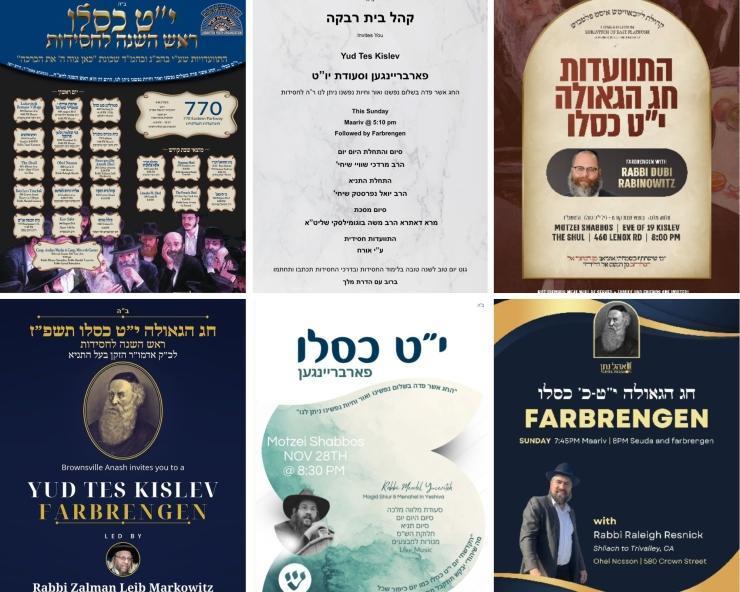
Planning Farbrengens for Large Gatherings
• There should be a “detailed plan of how to utilize this day [Yud-Tes Kislev] to spread the wellsprings of Chassidus, in a manner that will leave a lasting impression throughout the weeks and months that follow, since it is called the Rosh Hashanah of Chassidus and the ways of Chassidus.”
• The established custom is that the main Yud-Tes Kislev Farbrengen takes place on the evening of Chof Kislev, since the Geulah from imprisonment took place during Minchah, and three hours afterward, the Alter Rebbe was still in the home of his opponent, enduring emotional anguish, etc.
Nevertheless, in many places, Farbrengens are also held on the evening of Yud-Tes Kislev, and those who do so are surely blessed.
Generally, there are two approaches to arranging a Farbrengen:
1. To hold Farbrengens in numerous locations throughout the city, enabling people who would not attend a Farbrengen elsewhere to participate.
2. To gather all participants in one location, in which case, “With the multitude of people comes the glory of the King,” and the Farbrengen will include the elder and more distinguished members of the community, etc.
This presents the question of quantity versus quality, and the well-known discussion as to which is preferable…
My suggestion is that on the first evening, the eve of Yud-Tes Kislev, Farbrengens should be held in various locations, with announcements made there about the Farbrengen scheduled for the following evening. On the following evening, the eve of Chof Kislev, everyone should gather in one location for a Farbrengen…
• It is worthwhile and proper for every individual to arrange a Farbrengen (and preferably three Farbrengens, since “after three occurrences, something becomes established”): one personally and two through his emissaries, or by personally participating in all three, since they take place at different times – on the evening of Yud-Tes Kislev, during the day of Yud-Tes Kislev, and especially toward its conclusion, in a manner that continues into the evening of Chof Kislev.
These Farbrengens should be held with oneself (with all ten faculties of one’s soul), with one’s family, and with friends and acquaintances, etc. This further emphasizes that every individual is also a Mashpia, as it is written (in connection with the Geulah): “And he shall turn the hearts of the fathers to the children, and the hearts of the children to their fathers.”
• The following are suggestions made by the Rebbe, Melech HaMoshiach, to one of his earliest Shluchim, regarding the organization of a Yud-Tes Kislev Farbrengen in a Yeshivah:
The date of the Farbrengen and a brief explanation of its significance should be publicized in advance in the local newspapers read by the Jews of the area. Among the students, several should be prepared to recite a Maamar or, at the very least, a section of one. A group of Baalei Menagnim should also be organized in an orderly fashion. This will give the students a sense of pride and surely awaken a spirit of healthy competition among them, while also making the appropriate impression on the residents of the city and surrounding areas.
• Regarding institutions for girls, the Rebbe likewise suggested that several students deliver speeches about the holiday. Although they are generally assisted in preparing their speeches, their participation is important, and the very fact that they deliver speeches carries great value.
• Yud-Tes Kislev gatherings and Farbrengens are also relevant to the Shabbosim before and after the Yom Tov.
The Farbrengen
“The elders, the young men, and even the children – serve Hashem and accept upon yourselves the yoke of His sovereignty. Know that on this day, all our forefathers, beginning with the Baal Shem Tov, will assist you. Resolve to study Chassidus sincerely, and live! Be exceedingly careful on this holy day. L’Chaim V’Livracha!”
It is customary to sing the well-known Niggun on the words “Padah B’Shalom Nafshi” on the Yom HaGeulah. On various occasions, the Rebbe instructed that this Niggun be sung during the Farbrengen, and on one occasion, he instructed that it be sung already on Shabbos Mevarchim Kislev.
At the conclusion of Farbrengens during the Yud-Tes Kislev period, the Rebbe would sometimes begin singing “Padah B’Shalom” or the concluding words of the Niggun, “Va’ani Evtach Bach,” as he left the Farbrengen [and also on the nearby Shabbos and similar occasions].
Hachlatos: To establish fixed times for the study of Nigleh and Chassidus in public, and to strengthen the ways of Chassidus through friendship and brotherly love; to strengthen Avodas HaTefillah and Ahavas Yisroel; and to fulfill Mitzvos with light and enthusiasm.
All of this should be done in a manner of constant increase, in the three pillars of Torah, Avodah, and Gemilus Chassadim. This includes studying Rambam, three chapters each day; contributing financially to the institutions of Raboseinu Nesi’einu; and issuing “a call to all our Jewish brothers, may they live and be well, whose hearts are attuned to the ‘voice of a crying child’ – to undertake vigorous activities in spreading Torah in general and the wellsprings of Chassidus in particular, through both study and practical action, with enthusiasm, vitality, and light.”
Chalukas HaShas
The practice of dividing the Shas among participants is an ancient Jewish custom. In the words of the Frierdiker Rebbe:
“It is an ancient custom throughout the Jewish communities to complete the entire Shas every year, in every city, and wherever possible, in every Shul and Beis Midrash, through the division of the Masechtos.”
The efforts of the Alter Rebbe in this regard are well known. In his words:
“The entire Shas should be completed every year, in every city, by dividing the Masechtos through a lottery or by personal choice. In a city with many Minyanim, the Shas should be completed in each Minyan separately. If a particular Minyan is too small to accommodate the entire division, they should join with individuals from a larger Minyan. This must not be changed; it is an established and binding practice.”
The Rebbe Maharash writes: “At the very least, every individual should study one Masechta of Gemara each year.”
Accordingly, the custom was established to arrange the Chalukah of Shas on Yud-Tes Kislev, the Yom HaGeulah. Beginning in 5663 (1902–1903), due to the lack of time on Yud-Tes Kislev, the practice in Lubavitch was changed to hold the Chalukah of Shas on Chof-Daled Teves, the Yom Hilula of the Alter Rebbe. In 5713 (1952–1953), the custom of holding the Chalukah of Shas on Yud-Tes Kislev was reinstated in several locations [by the Rebbe].
When the Rebbe Rashab was overseas during the Chalukah of Shas, he would send a telegram announcing which Masechta he was taking upon himself.
The Chalukah of Shas encompasses several dimensions:
-
The individual fulfills the Mitzvah of Talmud Torah by studying the Masechta he has undertaken.
-
His study of that Masechta becomes part of the collective study of the entire Shas.
-
It is as though he is studying the entire Shas through a partnership with all the other participants.
-
His learning is considered as though it were performed together with ten or more people.
-
He grants and bestows upon each of the other participants a share in his own learning.
“It is certainly appropriate to post the list of participants in the Chalukah of Shas on the walls of the Shul. This will serve as encouragement and as a good reminder in the Sanctuary of Hashem. This is a Lubavitch custom.”
Those who find themselves in a location where, for whatever reason, the community is “too small to accommodate” the division of the entire Shas should join the Chalukah of Shas arranged at the Rebbe’s Beis Midrash through Machaneh Yisroel.
Torah Study
“Regarding his question as to what he should study during the twenty-four hours of this auspicious day, Yud-Tes Kislev… it is understood that the study should be in the teachings of the one being celebrated, namely, the teachings of Chassidus Chabad. This may be from his seforim, such as Sefer HaTanya, Torah Or, and Likkutei Torah, or from the Maamarim and Sichos of Raboseinu Nesi’einu, together with the explanations that have been added to them.”
At the conclusion of the Yud-Tes Kislev Farbrengen in 5712 (1951–1952), before Birchas HaMazon, the Rebbe instructed that an announcement be made:
“Those who have not yet completed the study of Sefer HaTanya should hurry to finish it, so as not to interrupt between the conclusion of Tanya and its beginning, just as on Simchas Torah we do not interrupt between Chassan Torah and Chassan Bereishis.”
On Yud-Tes Kislev, the annual cycle of daily Tanya study begins anew for a leap year, starting from the beginning of the Sefer, according to the division into daily portions established by the Frierdiker Rebbe.
The day’s Torah study should begin with subjects particularly relevant to the occasion. First and foremost, this includes the words of the Rebbe at the beginning of the Hayom Yom calendar, which discuss the special significance of Yud-Tes Kislev. A connection can be found in these words to every day, even when the calendar’s arrangement does not correspond to that year’s dates, particularly when one immerses oneself in their content.
Shacharis
“Chassidim have the custom to immerse in a Mikvah before Shacharis on Yud-Tes Kislev, following the accepted custom passed down from the early Chassidim in the name of the Baal Shem Tov, that one immerses in a Mikvah on Erev Shabbos and Erev Yom Tov, as well as on Shabbos and Yom Tov morning.”
Tachanun is not recited.
Yom HaGeulah – Chof Kislev
The day of the main Farbrengen: The principal Farbrengen takes place on the evening of Chof Kislev, as explained above at the beginning of the calendar, based on the Rebbe’s words.
Tachanun is not recited.
2
Join ChabadInfo's News Roundup and alerts for the HOTTEST Chabad news and updates!

Related Posts:

Most Popular


New Videos

Editor's Picks