
From Rebbe to Jung to Quantum Physics: The Truth that Less Means More

Rabbi Shlomo Ezagui explores the surprising convergence of Chassidus, Carl Jung’s psychology, and quantum physics, arguing that true fulfillment comes not through ego or material pursuits, but through humility, self-effacement, and connection to a higher Divine reality • Full Article


By Rabbi Shlomo Ezagui
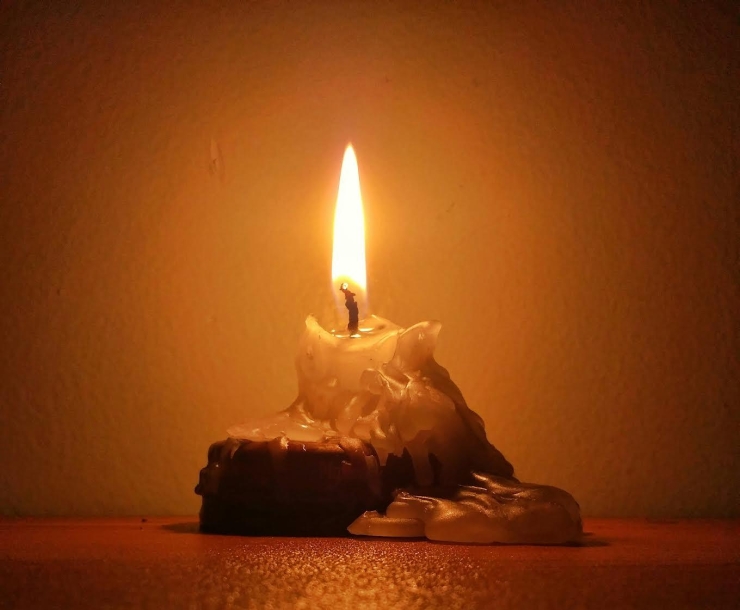
Photo: unsplash.com jacob vizek
Chassidic teaching offers a profound paradox: “The true Yesh is Ayin.” And “The Ayin is the true Yesh.”
Translated: the only real “something” is the “nothing” of self-effacement before God, and that “Nothing” is the only true “something”.
At the intersection of ancient spiritual wisdom, depth psychology, and modern quantum mechanics lies a profound, unifying revelation about the nature of human existence, consciousness, and reality.
When examining the foundational teachings of Rabbi Menachem Mendel Schneerson, Carl Jung’s psychological framework, and the principles of quantum field theory, a striking theme emerges: true substance, infinite potential, and enduring fulfillment are not found through aggressive self-assertion, material accumulation, or ego-driven control, but rather through the deliberate diminishment of the ego and the minimization of material obsession.
Far from advocating passive resignation or rejecting physical reality, these three distinct lenses show that stepping back from the frantic demands of the materialistic self enables an individual to align with a greater, unmanifested source of infinite blessings. Synthesizing these perspectives reveals a deeply transformative personal lesson: letting go of the illusion of absolute material importance is the only path to genuine happiness, divine purpose, and psychological wholeness.
To understand this paradigm through the wisdom of Rabbi Schneerson, one must examine his view of the physical world as temporary and subordinate.
In Chasidic thought, the material universe is not inherently evil, but it lacks independent, ultimate reality or substance of its own. When a person allows physical acquisitions, status, and material pleasures to take precedence in the mind and heart, an insurmountable spiritual barrier is created. Just as fire and water cannot dwell together in a single vessel, the love of the divine and the frantic pursuit of materialism cannot coexist in the human soul.
Rabbi Schneerson teaches that elevating physical matter to a permanent state of absolute importance results in a catastrophic detachment from the spiritual source that gives it life. The true purpose of human existence is not to worship the physical, but to regard the material world as transient and insignificant in its own right, and to transform it into a vessel and dwelling place for the divine through self-effacing service. By approaching physical actions—such as eating, drinking, and daily labor—with the recognition that they are merely transient vehicles for a higher purpose, the individual dissolves the illusion of materialistic supremacy. Consequently, the material world ceases to be an end in itself and becomes an open channel for infinite divine blessings, proving that when the ego stops inflating the importance of physical possessions, the space for true holiness is revealed.
This spiritual dynamic finds a striking parallel in Carl Jung’s psychological framework, particularly in his concepts of the psyche, the ego, and synchronicity.
Jung observed that a hyper-focused mind is often closed, desperately trapped in the narrow corridors of its own desires. When an individual fixates obsessively on securing a specific amount of wealth, a particular social status, or a rigid professional milestone, they impose a tight boundary on reality. This psychological tension creates a barrier, signaling to the universe that only one preconceived path is acceptable.
Jung recognized that this frantic lust for survival and control repels the very outcomes the individual is chasing, because it creates a state of psychological fragmentation dominated entirely by the ego’s defensive social masks. To break this cycle, an individual must cultivate open receptivity, which Jung described as a blockage or void in consciousness—a psychological tension that repels the very outcomes we seek.
This void is entirely distinct from apathy; rather, it is a deliberate release of the ego’s demand that reality conform strictly to its blueprint. When a person steps back, relinquishes the desperate need to force outcomes, and observes their life without frantic anxiety, the deeper layers of the psyche begin to operate. Meaningful coincidences, intuitive breakthroughs, and unexpected synchronicities begin to manifest as the individual finally stops fighting the natural flow of existence. This psychological surrender allows life to happen to the person rather than through forced exhaustion, mirroring the spiritual realization that letting go of ego-driven demands opens the door to profound inner peace and unanticipated grace.
Extending this principle from the human psyche to the fundamental fabric of the cosmos, quantum mechanics reveals the same structural truth at the subatomic scale.
In quantum physics, every particle—whether an electron, quark, proton, or atom—emerges from an underlying quantum field defined by pure, undifferentiated potentiality.
While a particle requires a distinct identity and specific characteristics, such as a particular spin vector, to function as an individual entity, the foundational paradox of quantum reality is that true power and unlimited potential do not arise from isolation. If a particle or a wave completely detaches itself from the greater ocean of the field, seeking to establish an absolute, independent existence, it would become nothing more than a temporary, disconnected entity, severed from the very source of its energy, and would cease to exist.
Here lies the paradox: a particle can exist only as an individual entity, preserving its identity, yet to remain connected to the infinite source of power, it must not sever its link to the field. The same holds for human beings. We gain our individuality through ego and self-definition, but if we cling too tightly to that identity—magnifying it through arrogance or materialism—we detach ourselves from the Source that sustains us. Just as a subatomic particle derives its reality from the broader quantum field, human consciousness derives its vitality from a transcendent, infinite source. When an individual dissolves their arrogant identification with transient physical forms, they reconnect with the field of pure potentiality, unlocking an inexhaustible reservoir of strength, creativity, and spiritual alignment.
Weaving together these three profound dimensions reveals a seamless, universal architecture of reality that transcends disciplinary boundaries.
Whether articulated as the theological imperative to make the physical world a dwelling place for the divine by stripping away its false permanence, the psychological necessity of creating an ego void to invite Jungian synchronicity, or the quantum reality of dissolving isolated wave identities to tap into the infinite field of pure potentiality, the core message remains the same. Across all three domains, materialism and the unbridled ego are portrayed as hollow, fragile, and ultimately restrictive constructs that alienate the individual from their true source.
The physical world and individual identity are not meant to be annihilated, but they must be properly contextualized as secondary, fleeting manifestations of a much deeper, infinite reality. When a person consciously chooses to loosen their grip on material accumulation and emotional self-importance, they stop swimming against the cosmic current. They stop competing in a materialistic game dictated by superficial metrics of success and instead begin to operate according to the organic laws of spirit and nature.
Ultimately, the personal lesson woven through Rabbi Schneerson’s spiritual insights, Jung’s psychology of the unconscious, and the mechanics of the quantum field is both challenging and deeply liberating.
True happiness and infinite blessings are never secured by frantic hoarding of physical goods or the relentless defense of a fragile ego. Instead, fulfillment arrives the moment an individual humbles themselves, recognizes the fleeting illusion of material permanence, and intentionally steps back to allow a greater reality to flow through them. By embracing humility, reducing our psychological and material footprint, and surrendering the ego’s demand for absolute control, we transform our lives into open vessels. In doing so, we move from exhausting, desperate striving to effortless harmony, where Hakadosh Baruch Hu – G-d Almighty, the universe, and the psyche converge to provide limitless sustenance, enduring peace, and profound, unshakable joy. (www.rabbishlomoezagui.com)
94
Join ChabadInfo's News Roundup and alerts for the HOTTEST Chabad news and updates!

Related Posts:



Most Popular


New Videos

Editor's Picks